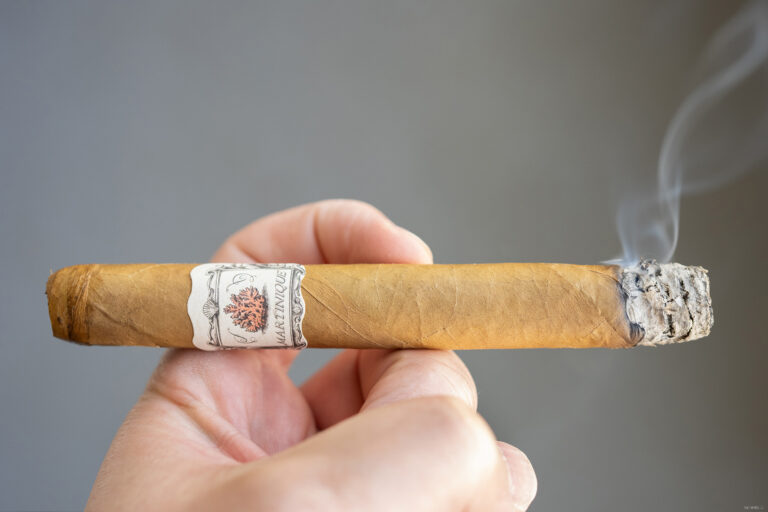
If I had to think of the core line of Principle Cigars, I would pick Martinique.
The line serves as the company’s Connecticut offering and, unlike the company’s Accomplice or Aviator Series lines, is rather straightforward: one blend, just a few vitolas.
In June, the newest Martinique debuted: a 5 1/2 x 43 corona.
While it wasn’t intended to be a store exclusive, currently, it is only available through Small Batch Cigar, the online storefront of MAXAMAR Ultimate Cigars in Orange, Calif. That’s because Small Batch bought the entire batch of the first production run.
The blend is listed as the same as the other vitolas—an Ecuadorian Connecticut-seed wrapper over a Dominican Monte Plata binder and fillers from the Dominican Republic and the U.S.A.—though the fillers have been tweaked so that the profile fits in between the existing Corona Gorda (6 x 46, $15) and Lancero (7 1/2 x 39, $16) vitolas.
Either later this year or early next year, the second shipment is slated to arrive, which will mean the cigar will be offered to other retailers.

- Cigar Reviewed: Principle Martinique Corona
- Country of Origin: Dominican Republic
- Factory: Kelner Boutique Factory
- Wrapper: Ecuador (Connecticut-seed)
- Binder: Dominican Republic (Monte Plata)
- Filler: Dominican Republic & U.S.A.
- Length: 5 1/2 Inches
- Ring Gauge: 43
- Shape: Round
- MSRP: $14 (Box of 20, $280)
- Release Date: June 2026
- Number of Cigars Released: Regular Production
- Number of Cigars Smoked For Review: 3
The Principle Martinique has a golden wrapper that has a soft and dry feel. Due to just how light the wrapper is, any imperfection is very easy to spot; that includes some wrapper stretching and slightly loose seams. The aroma from the first cigar is surprisingly full with lots of acidity and saltiness, a combination that makes me think of sweat, overtop some sweetness. The second and third cigars are medium-full and, in comparison, muted. There’s still some of the saltiness and acidity but a sweet pastry flavor is almost as strong. The feet have a scent that reminds me of a cinnamon roll leading some earth. It’s strongest in the first cigar, around medium-full, and weakest in the third, more medium-plus. The first cigar’s cold draw starts with a sharp, tingling sensation that disappears, leaving behind raisin, earth and some funky bitterness. The second cigar has caramel and plain crackers over some berry sweetness. The third cigar has granola and mango sweetness in front of mild salt and a horseradish-like tingle. While the flavors are all different, each is medium-full and slightly loose.
There are some classic Dominican flavors—a particular expression of woodiness, creaminess and toastiness—though they are joined by some more unique sensations like asphalt, tartness and mint. Each cigar starts medium-full and more alive than any of the cold draws. Very early on, the Martinique Corona warns that it’s quite delicate. Fortunately, it’s not a physical issue; rather, the flavor profile can easily get very sharp and toasty. When the cigar is at its best, there is creaminess, woodiness, sourdough bread, lemon and black pepper. However, just a bit too much heat in the cigar and the flavor profile gets overly toasty with burnt minerals, harsh pepper, and a vegetal flavor. While managing the main flavor is a task, I have even less luck with the finish, which tends to be sharper. Interestingly, even when the flavors in the mouth are too toasty or sharp for my liking, the retrohale remains quite enjoyable. Each cigar delivers tons of bread flavors—more like a soft dinner roll—with secondary notes of woodiness, white pepper, muted creaminess, and some plain popcorn. The finish heads back towards the main profile with black pepper, barnyard and soil. Flavor is medium-full to full, body ranges from mild to medium, and strength is more in between the two rather than the full range. While I’m regularly having to think about whether I’m smoking too quickly, and therefore heating up the cigar, there are no construction issues in the first third.

In the second third, there’s a Jekyll and Hyde contrast. Some puffs are quite enjoyable, but many are overly harsh or sharp. Unfortunately, the ratio leans towards the latter. The best puffs combine a creamy and black pepper undertone with some detailed earthy flavors—the best has some grilled mushroom-like accents—and salt. Too often, there’s a burning sharpness that seems at least twice as strong as the other flavors. The finish more or less mirrors the experience, though the flavors are different. The most interesting puffs have plain popcorn, lemon and white pepper, but a lot of times, it tastes like outside of the harshness, there’s little development during the finish. Retrohales of the second cigar are my favorite: smooth with sesame seed over a sour creaminess and earth. A lot of times, it’s bitter earth, sharp pepper and creaminess. Flavor is full, body is around medium; at its strongest, strength is mild-medium. Both the first and second cigars reach a point where combustion drops quickly, necessitating a single touch-up for each cigar. The third cigar is burning fine, though the ash is flimsy and not very pretty.

I think the ratio of enjoyable puffs to harsh puffs improves, but the floor drops in the final third. It’s not that the harsh puffs are harsher; rather, some of them offer little else in the way of flavor. Fortunately, there’s still some nuttiness and creaminess to complement the earth and pepper, though the better puffs are getting sharper and flirting more and more with harshness. The second and third cigars have some added sweetness, though it’s not enough to counteract the sharp elements. The finishes of the first two cigars are pretty predictable—more black pepper and fewer carryover flavors from when the smoke enters the mouth—but the third cigar is completely different. I sit through 10 seconds of some harsh earthiness and then there’s a great mixture of creaminess over sunflower seeds and tartness. At least in that cigar, the payoff is worth it. Like before, bread dominates the retrohale, though it’s more like the first third. Along with secondary notes of butter, unsweet floral flavors, kiwi and some roasted sensations, the bread lasts for five seconds before the black pepper comes in and spends 20 seconds drowning out everything else though some mild creaminess emerges at the tail end of it. The first two cigars require at least one more touch-up each, but the third cigar makes it start to finish without any combustion issues.

Final Notes
- Small Batch bought the first run of 250 boxes.
- While I’m a lancero fan, my favorite of the three Martiniques is the corona gorda.
- I don’t know if it’s due to the unique paper that is used or something else, but if you zoom in on these pictures, you can see individual dots of ink, as if this was printed via an inkjet printer. The paper material is thicker and more difficult than a standard cigar band.
- Cigars like this are the most challenging for me to score because there’s a huge gap between the good and the bad, with few puffs that land in between.
- These cigars would have been great for testing a cigar smoker. If you can manage the relationship between combustion and flavor of this cigar, you should be able to do it with any cigar that is properly made.
- I tried smoking at a quicker puff rate and it produced a slightly different flavor profile. For example, in the second third, it created a crisp aged tobacco that was enjoyable. Unfortunately, the crisp tobacco lasted for maybe five second and the harsh pepper lasted for close to a half minute. That trade-off, especially for the whole cigar, didn’t seem worth it.
- Rarely do I ever try to bring a full breath of smoke into my mouth. With the Martinique Corona, I was extracting even less smoke than normal because I was trying to manage the temperature of the cigar.
- Small Batch Cigar advertises on halfwheel.
- The cigars for this review were purchased by halfwheel.

- Principle lists the Martinique Corona as 5 1/2 x 43 coronas. Above are the dimensions I found for the three cigars smoked for this review. From a consistency standpoint, the measurements are super impressive.
- Final smoking time ranged between an hour and 30 minutes and one hour and 45 minutes.
- Site sponsor Small Batch Cigar carries the Principle Martinique Corona.
87
Overall Score
If the cigar god came down from tobacco heaven and told me this cigar was in a sick period, I’d believe the deity. I have a very difficult time believing that most of what I smoked is what was intended. First and foremost, it was probably the most challenging cigar to smoke of anything I’ve reviewed all year. Fortunately, that wasn’t due to terrible construction or excessive amounts of strength; rather, it seemed like the sweetspot for the flavor was in the narrowest of ranges, maybe even not present. Smoking at my normal puff rate, quite a bit slower than most, the cigar regularly tasted muted and harsh. Speeding up my puff rate predictably increased the harshness, while slowing down flirted with combustion issues and didn’t make the flavors that much more engaging. Having smoked some other Martiniques, this was quite surprising. This is the type of cigar that screams “do a redux review,” so expect one at some point in 2027.
Corona
Dominican Republic
Kelner Boutique Factory
Principle Cigars
Principle Martinique
Principle Martinique Corona
SmallBatchCigar.com