If you walk into a store and buy a cigar, the expectations are that the cigar will taste the same as if you made the purchase five years ago or five years from now.
Yet, a regular production line will either be regularly tweaked or is almost guaranteed to change over time. At some point, the factory will run out of a specific tobacco: be it seed, priming, farm or vintage. Then the factory has a choice: replace that tobacco with the next closest thing on paper, I.e., a close priming or the next year’s crop, replace it with the closest thing in terms of performance, perhaps moving to a different supplier, or replace it and adjust the other components to accommodate the end result.
While this scenario is common, it is rare for a company to acknowledge that it has reblended a successful line. Even rarer is a company pulling a successful line from the market due to tobacco sourcing issues. In the last few years, there have been two public instances of it: RoMa Craft Tobac with the original CroMagnon and the Eiroa Dark.
Early last year, Christian Eiroa, founder of CLE Cigar Co., said that he would be replacing the Eiroa Dark, which was introduced in 2019.


At some point, he ran out of the tobacco he deemed necessary to make the blend, which he often says is chasing a taste from his past. By February 2026, Eiroa said he had finalized the updated blend, though he declined to go into detail about what the updated blend is or how it’s different than the previous version. That said, he has acknowledged that it includes tobacco from Honduras as well as the company’s farms in Colombia, whereas the previous version was blended entirely of Honduran corojo.
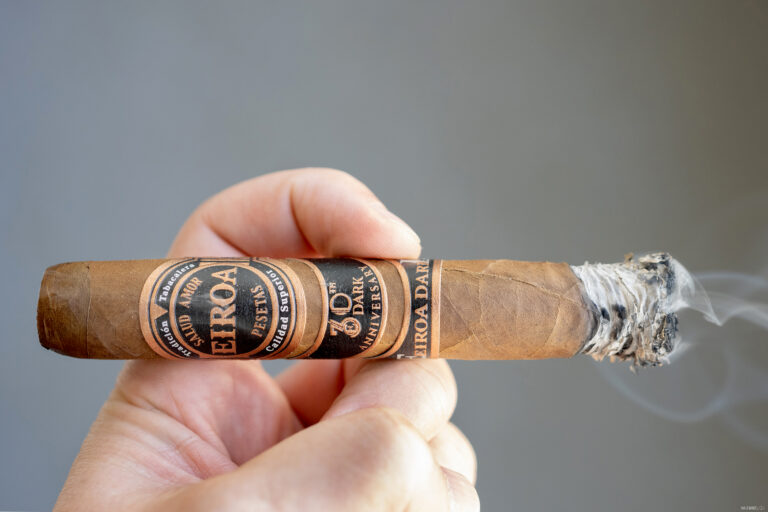
Beyond the blend, the branding has been updated to include “30th,” a reference to his 30 years in the cigar industry. The revamped Eiroa Dark 30th shipped to stores in June, offered in the three vitolas in which the line debuted, as well as the 11/18 perfecto that was a 2023 TAA release and the #7 cigar on halfwheel’s Top 25 of 2023.
- Eiroa Dark 30th 50×5 (5 x 50) — $18.06 (Box of 10, $180.60)
- Eiroa Dark 30th 11/18 (6 x 48/54/48) — $19.26 (Box of 10, $192.60)
- Eiroa Dark 30th 54×6 (6 x 54) — $19.26 (Box of 10, $192.60)
- Eiroa Dark 30th 60×6 (6 x 60) — $20.26 (Box of 10, $202.60)

- Cigar Reviewed: Eiroa Dark 30th 50×5
- Country of Origin: Honduras
- Factory: The CLE Factory
- Wrapper: Undisclosed
- Binder: Undisclosed
- Filler: Undisclosed
- Length: 5 Inches
- Ring Gauge: 50
- Shape: Round
- MSRP: $18.06 (Box of 10, $180.60)
- Release Date: June 2026
- Number of Cigars Released: Regular Production
- Number of Cigars Smoked For Review: 3
With the multitude of bands and tissue paper covering it, not much of the wrapper is immediately visible. However, it more or less looks like the old one. The wrappers are rustic-looking with multiple veins noticeably protruding off the leaf and some bumpiness coming from underneath. Each cigar is firm, with some harder spots at the top of the cigar. I’m surprised by how mild the wrappers smell. There’s not much on offer: some stale barnyard, woods and a hint of a floral flavor. The feet are medium or medium-plus with hints of roasted woods and aged tobacco. A stronger overall presence, but still not much in the way of distinct flavors. Cold draws are medium-full and chewy with lots of cereal notes and sweet grains on the first two cigars, and some added minerality and sharpness on the third.
After an abnormally lengthy time to light each cigar, things start with a medium-full profile of peanuts slightly stronger than the cereal flavor and with secondary notes of black pepper, toastiness and wood. While the flavors are great—rich and detailed—the burn line is struggling much earlier on than most cigars. The profiles of the first two cigars don’t evolve much, which I’m more than good with. The peanut flavor remains more prominent than the other flavors, though wood, brown sugar, aged tobacco, creaminess and black pepper aren’t too far behind. I opt to puff on the third cigar more quickly, hoping to outrun the burn issues. It has the peanut flavor, but a mineral earth flavor is almost as strong, and there’s more tartness and unsalted potato chips. Each cigar’s finish adds toastiness, strongest in the third cigar, and woodiness. The aforementioned third cigar’s profile ends up being quite similar to how retrohales of the first two cigars taste: aggressive, toasty and sharp. The third cigar has a sharp cinnamon and more of a bread core, at the expense of some of the sweetness. The finish increases the toastiness and the pepper, though I get some lemon in the second cigar. Flavor is medium-full or full, body is medium-plus and strength is medium-plus. Each cigar requires at least one touch-up for an uneven burn, though the other aspects of construction are all fine.

For the early parts of the second third, the peanut flavor that led the first third turns into more of a nutty medley. Underneath is some of the fruity sweetness, creaminess and meatiness; again with very little pepper. Given how the cigars started, I’m not surprised to find sections of the ash that are jet black, not burning properly and difficult to knock off in the ashtray. Once the issues arrive, those flavors mostly stick around, but there’s an increased amount of metallic aspects and also some sunflower seeds. The third cigar avoids the combustion issues, while having a more even profile of leather, nuttiness, black pepper and tartness. The finish of each cigar is drier, with secondary notes of creaminess, white rice and wood, though the biggest difference lies in the variance in toastiness. The retrohales seem less affected by the combustion issues. There’s sugar sweetness, creaminess, white pepper and leather. The third cigar adds peanuts and some lively woodiness as well. Flavor is full, while body and strength range from medium-plus to medium-full. I’m having to manage the burn of each cigar more and more, paying more attention to consistent and deeper puffs, rotating the cigar in the ashtray and, occasionally, using my lighter to touch things up. It’s not good, but fortunately, it’s not torpedoing the flavor.

Predictably, the combustion issues of the first two cigars are getting more frequent. The list of flavors is remarkably almost identical to the first third, but the cigars taste radically different than before. Whereas the nuttiness once had endless room to flow on the palate, it’s now confined to just a second or two of breathing before the sharpness really starts to take over. Again, the third cigar has a more balanced profile of earthiness, creaminess, brown sugar, buttery creaminess, and some tartness. Oddly, the list of flavors I find during each cigar’s finish is mostly the same: peanut butter, berries, toastiness and leather. Retrohaling provides a reprieve from the sharpness, instead serving up red apple, wood, meatiness, peanuts, black pepper, and, on the third cigar, toastiness. Flavor is full, body is medium-plus or medium-full, and strength is medium-full on the first two cigars, though full for the third cigar. At its worst, it requires four touch-ups to get through the final third. It’s not great, but I kept the cigars from going out.

Final Notes
- If I know I’m going to review a cigar, I try to avoid smoking it or any of the other vitolas before smoking the review cigars. I’ve smoked a handful of the Eiroa Dark 30ths in different vitolas and have not experienced any of the issues I found with the cigars from this box. My recollection is that construction has been fine, not perfect. Other than this bullet point, the review and score are based solely on the three cigars I smoked for the review.

- For the last three or four months, I’ve decided to use a soft flame lighter to start each cigar. I mainly wanted to see if I’d taste any difference from its lower temperature versus a torch flame. The Eiroa Dark was very difficult to get lit with a soft flame, each cigar turning jet black like you can see above. This lasted for probably around two minutes before lighter gray ash started to appear.
- I experimented with an extra cigar and found that when using a torch, it took longer than normal to light but wasn’t as pronounced as with the soft flame. In addition, the issue seemed to be related to the filler.
- I’ve been told by multiple factory owners that this type of issue is underfermented tobacco. The signs include jet black color, cooler temperature than the rest of the ash, not wanting to easily break off the cigar, and being unable to burn normally, almost resistant to a lighter. For many years, I rarely ever experienced the issue. However, since 2020, it’s become something we, collectively, at halfwheel seem to be experiencing about once per month. I’d rank it as the second-worst construction issue, better than having a plugged cigar.
- Typically, I find that once the black ash appears, it’s game over for my enjoyment of a cigar. In my experience, that part of the cigar won’t burn, which makes a mess of both the flavor and the construction.
- After seeing the feet of the cigar turn jet black, I was ready for a disaster. My past experiences have been that once the black ash shows up, the cigar is going to keep having burn issues, and the intervals between lighter interventions will shorten. After about the third one, the flavor profile is destroyed. This was an exception. It wasn’t how I’d want a cigar to smoke, but I enjoyed the flavor.
- The combustion was so bad that this cigar benefited from how we score combustion issues. After a couple of issues in a single section, our scoresheet stops deducting points.
- I reviewed the original Eiroa Dark 11/18 and enjoyed it so much that after the review, I purchased a box to smoke. That might happen every other year. I’ve not yet smoked the 30th version.
- CLE Cigar Co. advertises on halfwheel.
- The cigars for this review were purchased by halfwheel.

- CLE Cigar Co. lists these cigars as 5 x 50 robustos.
- In an effort to try to outrun some of the combustion issues, I puffed on the third cigar much more frequently, i.e. quicker, than the other two. While there were clear signs of how the quicker puff rate affected things—the flavor, fewer touch-ups—it made absolutely no difference to the final smoking time. Each cigar took an hour and 40 minutes for me to smoke.
- Site sponsor Small Batch Cigar carries the Eiroa Dark 30th 50×5.
88
Overall Score
I would have loved to have smoked three cigars without major combustion issues as I’d have a much clearer picture of what I imagine is a way more complex second half flavor profile than what I experienced. In the early parts, when the cigar is given time to cool without risk of combustion issues, there’s a contrast between the lighter, nuanced flavors and an old-school thump that most of the stronger cigars of the modern era don’t have. It was quite good, but short-lived. Unfortunately, what I’ll remember most from this review is that I got a batch of cigars with problematic filler. The original Eiroa Dark has been my favorite CLE cigar, and the new one might be able to give it a run for its money; it just has to burn right.
CLE Cigar Co.
Eiroa Dark
Eiroa Dark 30th
Eiroa Dark 30th 50×5
Honduras
Robusto
The CLE Factory