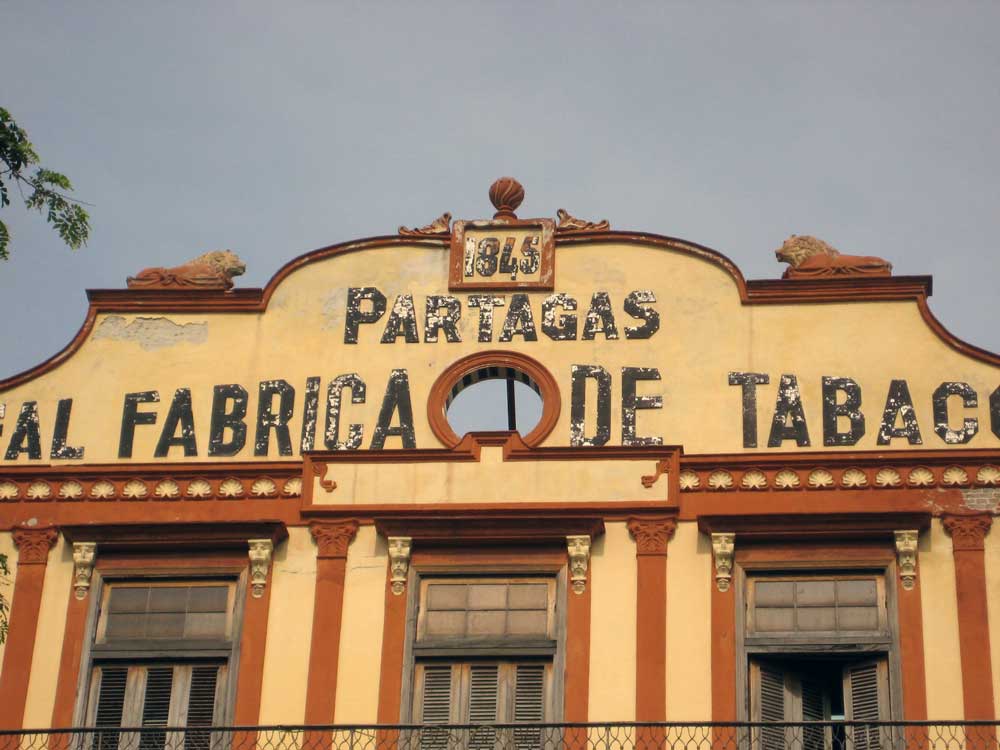
Partagás is one of the oldest cigar brands in existence, established in Havana in 1845. Today, the name is used by two separate and competing entities: one produced in Cuba for the state-owned tobacco company Habanos S.A., and the other, made without Cuban tobacco, produced in the Dominican Republic for General Cigar Company, a subsidiary of Swedish Match.
History
The Catalan Don Jaume Partagás i Ravell (Arenys de Mar, 1816 – Vuelta Abajo, Cuba, 1864), son of Jaume Partagás and Teresa Ravell, emigrated to Cuba and, with the assistance of Joan Conill, a businessman from Lloret de Mar, founded a small tobacco factory in Havana in 1827. Later, in 1845, he established his own factory, the Royal Partagás Tobacco Factory, at 60 Industria Street in Havana, one of the largest tobacco factories of its time.
The name, translated as “Royal Partagás Tobacco Factory,” was reportedly chosen because of its status as a supplier of cigars to various European and Asian noble families. Don Jaume owned many of the finest plantations in Cuba’s renowned Vuelta Abajo tobacco-growing region. His access to the island’s highest-quality tobacco contributed significantly to the company’s remarkable success.
Don Jaume is also believed to have experimented with various tobacco fermentation and aging techniques. He is famously credited with hiring the first lector, a reader who entertained and educated cigar rollers by reading aloud while they worked, a tradition that became deeply rooted in Cuban cigar culture.
Don Jaume was murdered on one of his plantations sometime between 1864 and 1868, allegedly by a jealous rival involved in one of his romantic affairs. His son, Josep Partagás, assumed control of the business. The factory and brand were later sold to banker José A. Bance, who in turn sold them to Cifuentes, Fernández y Cía. in 1900.
In 1916, José Fernández apparently left the company, and Ramón Cifuentes Llano partnered with Francisco Pego Pita to form Cifuentes, Pego y Cía. In 1927, the company acquired the rights to the Ramón Allones brand and later began producing a cigar brand under its own name, Cifuentes.
Ramón Cifuentes died in 1938 and Francisco Pego in 1940, leaving the Cifuentes family in sole control of the increasingly prestigious factory and brand. The company was subsequently renamed Cifuentes y Cía. In 1954, the family acquired the Bolívar and La Gloria Cubana brands from José F. Rocha and moved their production to the Cifuentes factory.
By 1958, the company ranked second only to H. Upmann in Cuban cigar exports, accounting for more than one-quarter of all Cuban tobacco exports.
Both before and after the Cuban Revolution, the Cuban-made Partagás remained one of the world’s most respected and best-selling cigar brands. By the mid-1990s, it was still the second best-selling Cuban cigar brand after Montecristo, with annual sales of approximately 10 million cigars.