Earlier this year, Casa Carrillo announced a new regular production line named Ascend, which the company says was inspired by the idea of progression. To that end, the blend was created to feature an evolution of flavors from the beginning to the end, while the three vitolas are named after basic landforms in mountain topography that describe the shapes of hills and mountains from shortest to tallest.
The line uses an Ecuadorian habano wrapper, a binder grown in Estelí, Nicaragua, and Nicaraguan filler tobaccos. The cigars are made at Casa Carrillo’s factory in Santiago, Dominican Republic.
Casa Carrillo says that “the blend was developed to create a smoking experience that evolves gradually, allowing each stage to reveal new dimensions of the tobacco’s character.”
Ascend debuted in three different violas, all packaged in 20-count boxes:
- Perez-Carrillo Ascend Saddle (5 x 50) — $12.75 (Box of 20, $255)
- Perez-Carrillo Ascend Ridge (6 x 52) — $13.75 (Box of 20, $275)
- Perez-Carrillo Ascend Peak (6 1/4 x 58) — $14.95 (Box of 20, $299)

- Cigar Reviewed: Perez-Carrillo Ascend Ridge
- Country of Origin: Dominican Republic
- Factory: Casa Carrillo
- Wrapper: Ecuador (Habano)
- Binder: Nicaragua
- Filler: Nicaragua
- Length: 6 Inches
- Ring Gauge: 52
- Shape: Pressed
- MSRP: $13.75 (Box of 20, $275)
- Release Date: July 2026
- Number of Cigars Released: Regular Production
- Number of Cigars Smoked For Review: 3
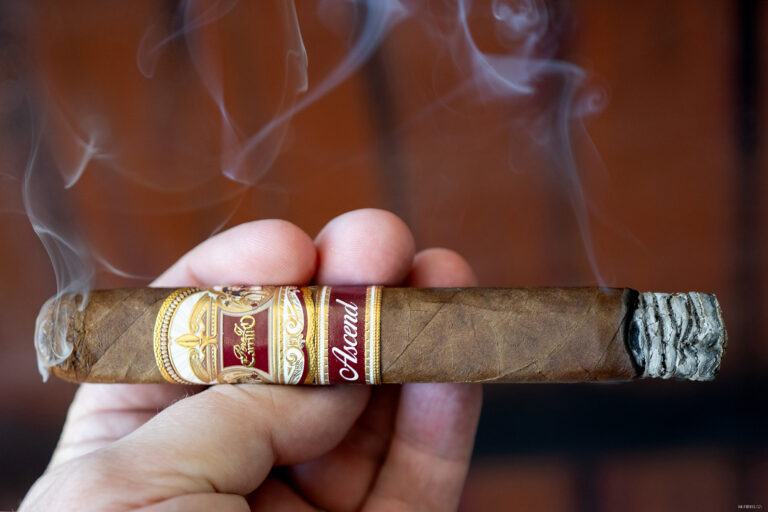
Mostly due to the obvious oval press each cigar has, the Perez-Carrillo Ascend Ridge looks a bit different. The wrappers are a dark, mottled brown, with almost no oil visible. When I run my fingers down the length of the cigars, the wrappers feel like parchment, but there are only a couple of thick, protruding veins on each, and all three cigars are firm with no soft spots. Aroma-wise, a sour earth note is the first thing I notice on the first and second cigars—the third cigar is missing that note entirely and is much creamier in nature—but, in general, the aromas are fairly light with leather, dry woodiness, hay and milk chocolate. Scents from the feet are much stronger and include creamy cedar, cinnamon, cocoa nibs, leather tack, generic nuttiness and bready graham crackers. The cold draws are led by a strong and somewhat bitter dark chocolate flavor, followed by almonds, creamy cedar, vanilla sweetness, baker’s spices, and light nutmeg.
The three cigars start off pretty much the same, with lots of spice on my tongue and strong notes of anise and black pepper. After more than 15 puffs, the profile transitions to the main flavors of terroir and leather on the first cigar, while the second and third cigars feature a combination of dry cedar and creamy cashews. At various points, secondary notes of cinnamon, toasted bread, gritty earth, bitter espresso, baker’s spices, and a touch of floral show up. While the first cigar has a fairly standard combination of black pepper and vanilla sweetness, there is a distinct but not overwhelming red pepper on the finish of the second and third cigars—it is strongest on the second cigar—and that note also shows up on the retrohale, where it is combined with a light graham cracker sweetness. Flavor for the first cigar ends the first third at medium-full, while the other two cigars are at full, the body is between a strong mild and a solid medium and the strength of all three cigars hits a solid medium. Construction-wise, the first cigar needs two separate burn corrections to stay on track, but that’s the only issue.

During the second third, the second Perez-Carrillo Ascend Ridge rises above the other two, mostly due to a new caramel sauce sweetness on the retrohale that combines wonderfully with the red pepper that is still present. The first cigar continues to be less interesting in the flavor department with main flavors of earth and leather, while the second and third cigars have more captivating main flavors of cocoa nibs and creamy cedar. Secondary notes include coffee grounds, baker’s spices, creamy hay, anise and light chalk. On the retrohale of the third cigar, a combination of graham crackers and red pepper is still present—albeit slightly less than what I noted in the first third—while the first cigar sticks with black pepper and sweet vanilla. Flavor intensity does not change—medium-full for the first cigar, full for the second and third cigars—while the body and strength are at a solid medium. Two cigars need a single burn correction each, but the draw resistance is excellent, and there is plenty of smoke production.

The final third sees a return to the profiles that were present in the first third, which means the first cigar features earth and leather, while the second and third cigars are full of both dry cedar and creamy cashews. However, there are some new secondary flavors, including notes of rich coffee beans, herbs, potato chips, chalk and sourdough bread. Shortly after the halfway point, the caramel sauce note from the second third disappears and does not return—it never shows up at any point in the other two cigars, sadly— leaving behind a combination of red pepper and bready graham cracker sweetness on the retrohales of the second and third cigars, while the first cigar retains its familiar sweet vanilla and black pepper. Once again, two cigars need burn corrections—the first cigar needs two, while the third cigar needs one—but there are no other problems.

Final Notes
- I really do love the pressed oval shape of cigars; they just seem to fit into my mouth more comfortably than round or square shapes.
- Interestingly, a saddle has multiple definitions beyond the one you put on a horse. In topography, it is a low, dip-like depression that is located between two higher peaks, forming a shape reminiscent of a horse saddle. According to Wikipedia, in mathematics, it is “a point on the surface of the graph of a function where the slopes (derivatives) in orthogonal directions are all zero (a critical point), but which is not a local extremum of the function.

- When I removed the band from my first cigar, a chunk of the wrapper was taken with it. Thankfully, there were no construction issues as a result.
- The cigars for this review were purchased by halfwheel.

- These cigars are listed as being 6 x 52 vitolas. Above are the measurements we took when we measured them.
- The final smoking time averaged out to one hour and 56 minutes for all three cigars.
- If you would like to purchase any of the cigars, site sponsors Atlantic Cigar Co., Cigars Daily, Cigars Direct, Corona Cigar Co. and Small Batch Cigar sell them on their respective websites.
88
Overall Score
When I finished with my first Perez-Carrillo Ascend Ridge, I was a bit perplexed with what I had experienced: instead of a progression or evolution of flavors, the profile was fairly bland and unexciting, and there were multiple burn issues that needed to be addressed. Thankfully, the second and third cigars reversed my opinion by featuring more complex flavor profiles and a red pepper note on both the finish and the retrohale—just aggressive enough to enhance the profile without becoming a detriment. In the end, while my experience with the Ascend line was not as consistent as I would have liked, the second and third cigars show just how this blend can be when it is hitting on all cylinders.
Casa Carrillo (Company)
Casa Carrillo (Factory)
Dominican Republic
Perez-Carrillo
Perez-Carrillo Ascend
Perez-Carrillo Ascend Ridge
Toro