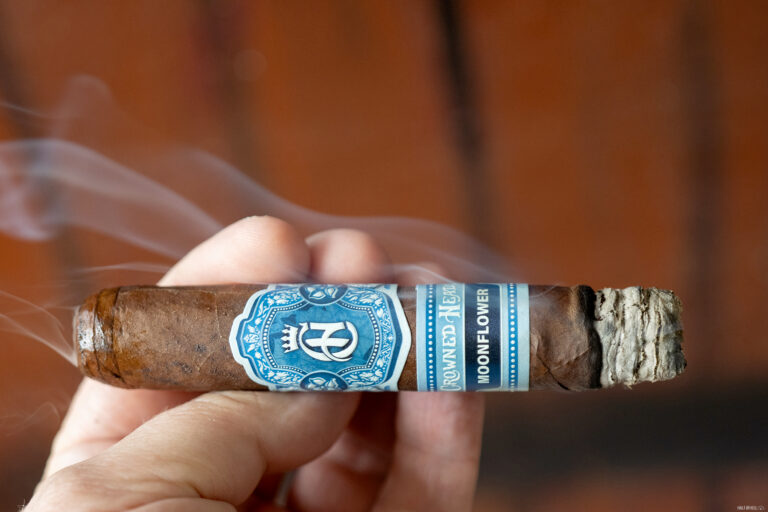
In March, Crowned Heads announced a new regular production line named Moonflower that was inspired by the flower of the same name, which is seen by some—including company co-founder Jon Huber— as a symbol for overcoming struggles and challenging times.
Interestingly, not only is all of the tobacco for Moonflower grown on farms owned by My Father Cigars, but it also marks the first time in a decade that Crowned Heads has had a new regular production line produced at the My Father factory in Estelí, Nicaragua.
Blend-wise, Moonflower is a Nicaraguan puro with a corojo-seed wrapper over two binders—one grown in Estelí, the other grown in Jalapa—and a combination of filler tobaccos from Condega, Estelí and Jalapa. According to Huber, the blend is a “riff” on the company’s discontinued Las Mareas line, and even includes some of the same tobaccos.
“(Moonflower is) a celebration of partnership, tradition, and holds a deeply personal symbolic meaning to me, as well,” said Huber in a press release. “We’ve poured everything into creating something truly special: a cigar that delivers complexity, balance, beauty, and that unmistakable ‘wow factor our supporters expect from Crowned Heads.”
There are three different violas of Moonflower, each packaged in 21-count boxes:
- Moonflower Robusto (5 x 52) — $12.95 (Box of 21, $271.95)
- Moonflower Corona Gorda (6 x 46) — $11.95 (Box of 21, $250.95)
- Moonflower Toro (6 x 54) — $13.50 (Box of 21, $283.50)
Boxes of all three sizes in the Moonflower line started shipping to retailers in mid-June.

- Cigar Reviewed: Moonflower
- Country of Origin: Nicaragua
- Factory: My Father Cigar S.A.
- Wrapper: Nicaragua (Corojo)
- Binder: Nicaragua (Estelí & Jalapa)
- Filler: Nicaragua (Condega, Estelí & Jalapa)
- Length: 5 Inches
- Ring Gauge: 52
- Shape: Round
- MSRP: $12.95 (Box of 21, $271.95)
- Release Date: June 2026
- Number of Cigars Released: Regular Production
- Number of Cigars Smoked For Review: 3
Due to the two bands and foot ribbon that take up so much of the visible space, it is a bit difficult to see many details on the wrappers of this vitola. Taking off the foot ribbons reveals dark brown wrappers with plenty of mottling and veins, but very little oil that I can see. However, I do notice that the foot on my second cigar has a noticeable box-pressed look to it, while the other two cigars are almost completely round, more on that in the Final Notes below. Despite that lack of oil, the wrappers on all three cigars are very smooth to the touch, and they are all nicely firm when squeezed. A sweet and creamy—albeit fairly generic—woodiness leads the aromas coming from the wrappers, followed by raisins, leather, barnyard and dank earthiness. That raisin sweetness is easily the leading aroma emanating from the feet of all three cigars, but there are also notes of creamy cedar, dark chocolate, dry hay, white bread and a light vegetal note. After straight cuts, the cold draws are full of creamy cedar and cocoa nibs notes, along with a substantial amount of black pepper—much more on the second cigar than the other two—coffee grounds, generic breadiness, creamy nuts, leather tack and yes, more raisin sweetness.
A strong anise flavor combines with some light spice and black pepper start the three cigars off, but all three of those flavors dissipate quickly, as flavors of cocoa nibs and cedar take over the profiles of the first two cigars, while the last cigar features charred meat and espresso. There are also notes of leather tack, baker’s spices, gritty earth, peanut butter, and toasted bread, but none of them come close to the strength of the main flavors at any point. The amount of spice on my tongue actually increases for the first cigar, but by the time the burn line hits the halfway point of the first third, there’s no spice on the other two cigars. On the retrohales, the first and second cigars are in lockstep, with light black pepper and some enjoyable but mild raisin sweetness, while the third cigar features a fantastic combination of red pepper and a cherry sweetness that really makes its profile sing. The finish on all three cigars is a generic but not unpleasant earthy flavor, and while it is most aggressive on the second cigar, it is not strong enough to really impact the overall profiles. Flavor is full, the body is at a point under medium and the strength hits a solid medium. Two of the cigars need a minor touch-up with my lighter to stay on track, but those are the only construction issues.

There are virtually no changes in the profiles of the three cigars during the second third, meaning the first two cigars continue to have a strong combination of cedar and cocoa nibs at the top, while the third cigar sticks with the rich espresso and charred meat flavors. Additional flavors of gritty earth, cinnamon, pencil lead, hay, roasted peanuts and light chalk show up at various points, while the earthy note remains on the finish for all three cigars. There is now more raisin sweetness and less pepper on the retrohale of the first cigar—although the second cigar actually has more pepper—while the third cigar has not budged from its combination of red pepper and cherry sweetness. Flavor remains at full, the body hits a solid medium and the strength increases slightly to land a point just north of medium. Once again, there are two burn corrections needed—the same two cigars, in fact—but once again, those are the only problems of note when it comes to the construction.

The changes come hot and heavy in the final third, as all three cigars feature new dominant flavors. The first and second cigars now feature a blend of burnt bread and cedar, while the last cigar has shifted to the main flavors of roasted peanuts and rich coffee beans. Milder flavors of dry earth, cinnamon, chalk, leather tack and herbs flit in and out, but the earthiness remains in place on the finish of all three cigars. The first two cigars now feature a bit more pepper and new milk chocolate sweetness on the retrohale, and while the cherry note is still present on the third cigar, the amount of red pepper has noticeably increased. Flavor ends at full for all three cigars, but the body of the first and second cigars stays just above the medium mark and solid medium strength; the third cigar increases to medium-plus for both strength and body. Two cigars need quick corrections to stave off any further burn issues, but the draw resistance and smoke production are problem-free.

Final Notes
- Jon Huber has two moonflowers tattooed on his left hand, along with the name of his wife.
- The flavor profiles were not the only difference between the first two cigars and the last: the last cigar took almost 20 minutes longer to finish, had substantially more spice in the final third, and ended up a bit stronger than the other two.

- While two of my cigars had round feet, the second one had more of a pressed look to it on one side, as you can see in the photograph above.
- I was a bit surprised at how much black pepper there was on the cold draws—especially in the second cigar—considering that note was virtually nowhere to be found on the wrapper or feet of the cigars.
- The cigars for this review were purchased by halfwheel.

- These cigars are listed as being 5 x 52 vitolas. Above are the measurements we took when we measured them. The UPC sticker on these cigars incorrectly lists the ring gauge as 50 instead of 52.
- The final smoking time averaged out to two hours and three minutes for all three cigars.
- If you would like to purchase any of the Moonflower cigars, site sponsors Atlantic Cigar Co., Cigars Daily, Cigars Direct, JR Cigars and Small Batch Cigar sell them on their respective websites.
87
Overall Score
It is always interesting to me when one of the three cigars we smoke for a review has a different profile from the other two, if only because I am left wondering which profile was meant to be the final cut, no pun intended. The first two cigars were enjoyable—albeit not exactly mind-blowing—but the last cigar was ramped up in multiple ways: the profile was not only richer and more nuanced, but it also had layers of flavor the other two cigars lacked. Having said that, all three cigars needed at least one burn correction to stay on track, and while none of the issues were major, I did have to keep my lighter handy. In the end, the third Moonflower showed me just how good this blend can be, and while I wish the other two cigars were similar to that one, even at its worst, this is a very solid release from Crowned Heads.
Crowned Heads
Moonflower
Moonflower Robusto
My Father Cigars S.A.
Nicaragua
Robusto