
As part of its Grand Opening, I recently had an opportunity to tour Selected Tobacco’s production facility and factory in Madrid, Spain. Earlier this year, word came that Selected Tobacco opened a factory in Madrid. According to Selected Tobacco, it’s the first premium cigar production facility opened in more than 50 years. Media, retailers, and invited guests descended on Madrid for a two-day grand opening event that included a facility tour and a gala dinner. In this feature story, we will take a look at the facility. We will later publish an article on the gala dinner and articles about my trip to Spain.
Who is Nelson Alfonso?
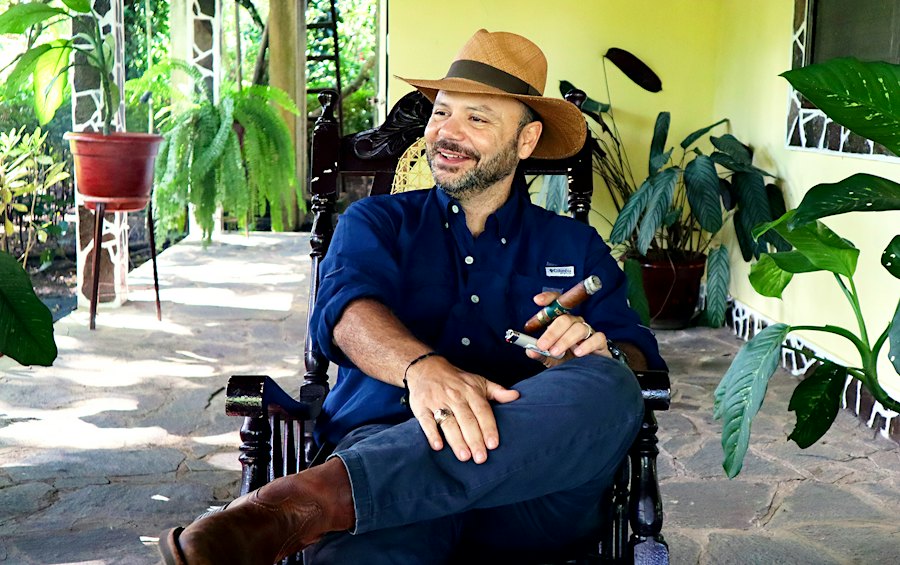
The operation of Selected Tobacco is headed up by Nelson Alfonso. Nelson Alfonso comes from Cuba, and he started out as an artist. In fact, he was jailed for a while in Cuba. For many years, he has been the artistic force behind much of the packaging for Habanos S.A., as well as other companies.

The Byron brand traces its origins to Cuba in 1850 when the “Lord Byron” was created by Alfonso’s great-great-great-grandfather. The original cigar was made in a small factory in Santiago de las Vegas, Havana province, Cuba. The name Byron honors George Gordon Byron, better known as “Lord Byron,” a renowned English poet. The brand lasted over 80 years before folding during the Great Depression of the 1930s. After learning about his family’s heritage in the cigar business from his grandfather, Alfonso was inspired to revive the Byron brand. He acquired the name in 1998; around 2010, he returned it to market with two other brands, Atabey and Bandolero.
An Overview of the Facility
Selected Tobacco is located in a five-story facility in the northeast part of Madrid, near the Adolfo Suárez Madrid-Barajas Airport. While I’ve seen multi-story factories before, I haven’t seen a five-story facility.

The breakdown of the facility is as follows:
- Floor 1: Welcome reception area, warehouse, and art gallery
- Floor 2: Selected Tobacco Design and Packaging
- Floor 3: La Galera (Rolling Room), Cigar Aging Rooms
- Floor 4: Cigar Aging Rooms, Executive Offices, and Showroom
- Floor 5: Private Smoking Lounge with Outdoor Terrace and Humidor
- Rear: Another section of the building where tobacco fermentation takes place. There is also a Hydroponic Tobacco Lab
The Production Tour
I’ve toured many premium cigar factories. Each always has its own unique character and charm. I’ve toured some pre-industry facilities as well. The Selected Tobacco facility encompasses everything from seed to shipping. It’s unique not only in its construction, but also in the techniques used to work with tobacco.
The Back of the Facility
The back of the facility is dedicated to the tobacco itself. When you enter this part of the facility, a sign explains what “Selected Tobacco” means. Translating the sign below it says, “Fermentation and aging process for extra-aged tobacco leaves sourced from small selected farms in Peru, the Dominican Republic, Nicaragua, and Ecuador.

In addition, Selected Tobacco is working on selecting its own tobacco through what it calls a Hydroponic Growing Room.
The Hydroponic Growing Room
There is tobacco being grown for premium cigars in Spain. We saw this recently with the Macanudo Emissary España, where they grow tobacco in the Extremadura region of Spain, located in the country’s west-central part.

It’s no surprise that Selected Tobacco is looking to grow tobacco in Spain. The Hydroponic Growing Room is a laboratory where Nelson Alfonso works on experimental hybrid seeds and cultivates tobacco plants with that goal in mind. Hydroponic growing rooms use water-based nutrients to grow plants without soil. This facility features a sophisticated lighting system that allows for indoor plant growth and provides climate control. Although the outcome and specific locations for tobacco growth remain somewhat uncertain, the laboratory itself was quite impressive.

Fermentation and Tobacco Aging
As for the tobacco, since it was sourced by Selected Tobacco, it will undergo a combination of fermentation and aging. This includes fermenting the tobacco in traditional pilotos, aging it in bales, and aging it in oak barrels.
When the tobacco starts aging, it moves to separate rooms. Younger tobaccos are aged separately from the older tobaccos. As you move from one room to another, you smell the ammonia of younger tobaccos aging in one room, then the sweetness of tobaccos that have been aging for some time.

The tobacco is then aged in French Oak barrels previously used for wine. These barrels also help remove more resins and ammonia while letting the leaves age naturally.

In the French Oak barrel aging process that follows, different barrels are used for different types of tobacco. The inside French Oak barrels used for the wrapper are “scraped” to remove impurities that could compromise the tobacco during aging.

On the other hand, the binder and filler are aged in “no scraped” barrels to leverage some of those flavors and aromas.

Rolling Cigars
Once the tobaccos complete the aging process (a five-year process), they are ready to roll cigars. Currently, the tobacco is shipped to Tabacos de Costa Rica for this stage. Once rolled, the finished cigars return to Spain (and as we will see, more aging occurs). Back in 2019, I visited Tabacos de Costa Rica, a very high-caliber factory. Nelson Alfonso takes great care with his processes, so he simply won’t trust some random factory. I visited Tabacos de Costa Rica in Puriscal, Costa Rica, in 2019, and I can attest that he is working with a world-class facility.

The model of aging tobacco in Europe, outsourcing cigar production to Latin America, and re-aging the finished cigars in Europe is not unique to Selected Tobacco. The Meerapfals use a similar model in Belgium. However, I will venture to say that Meerapfal and Selected Tobacco are unique in the processes they use in their home countries.
At the same time, Selected Tobacco will be doing some rolling of its own at its Madrid facility. We saw the beginnings of a new galera located on the 3rd floor in the factory. Selected Tobacco has not said which specific cigars they will roll in that room. To start, six pairs can work the room. There are goals of eventually rolling 500,000 cigars in Spain.

This was the first time I think I saw a factory with brand-new Lieberman Machines (for bunching) and brand-new cigar molds operating simultaneously.

Aging Rooms
This is described as the heart of Selected Tobacco. The aging rooms store the finished cigars. The aging rooms sit on floors three and four with a courtyard atrium in the center. At the back of the fourth floor stands a replica of a bronze sculpture on the family tomb of Nelson Alfonso’s parents.

As Oliver Nivaud, Director of Operations for United Cigars, who distributes Selected Tobacco in the U.S. market, talks about, it was important to have this family emblem in the epicenter of the Selected Tobacco operation.
d
The rooms show two types of cigar aging. Those aged in cedar and those aged in French Oak barrels. First, in the aging process, Nelson Alfonso uses a cycle of raising and lowering humidity. Cedars play a role by absorbing moisture at higher humidity and releasing it during aging. At the same time, the tobacco’s compounds react to these changes. On top of that, Alfonso relies on six types of cedar, each with its own unique characteristics.


A similar process of cycling through different humidity levels is used for cigars aged in French Oak. The Selected Tobacco portfolio uses French Oak for selected cigars.
Executive Offices
We got a glimpse into the executive offices on the fourth floor. Outside of a few other factories (such as Arturo Fuente), these are probably some of the most modern executive offices I’ve seen at a production facility.

Design and Packaging
When it came to packaging and design, we were asked to put the cameras down as there were several third-party projects Selected Tobacco was working on and they (as well as we) wanted to respect that. That said, Selected Tobacco’s world-class products are on display throughout other parts of the facility. The picture below comes from the reception area.

The Fifth Floor Lounge
The fifth floor is dedicated to a smoking lounge. It includes an indoor lounge and an outdoor terrace. The indoor lounge has comfortable seating, and there are lockers for members.

It should be no surprise that the indoor lounge contains humidified cigar lockers.

There is also a two-story humidor that has an assortment of Selected Tobacco cigar lines to smoke.

The outdoor terrace provided excellent views of the Madrid region.

The Warehouse
The warehouse, where shipping and receiving take place, is on the ground floor. Because the warehouse was used for reception and the next night’s gala, black curtains hid the products stored there.

By design, this area can be converted for events. This included the weekend events for the tour and grand opening gala.
The Art Gallery
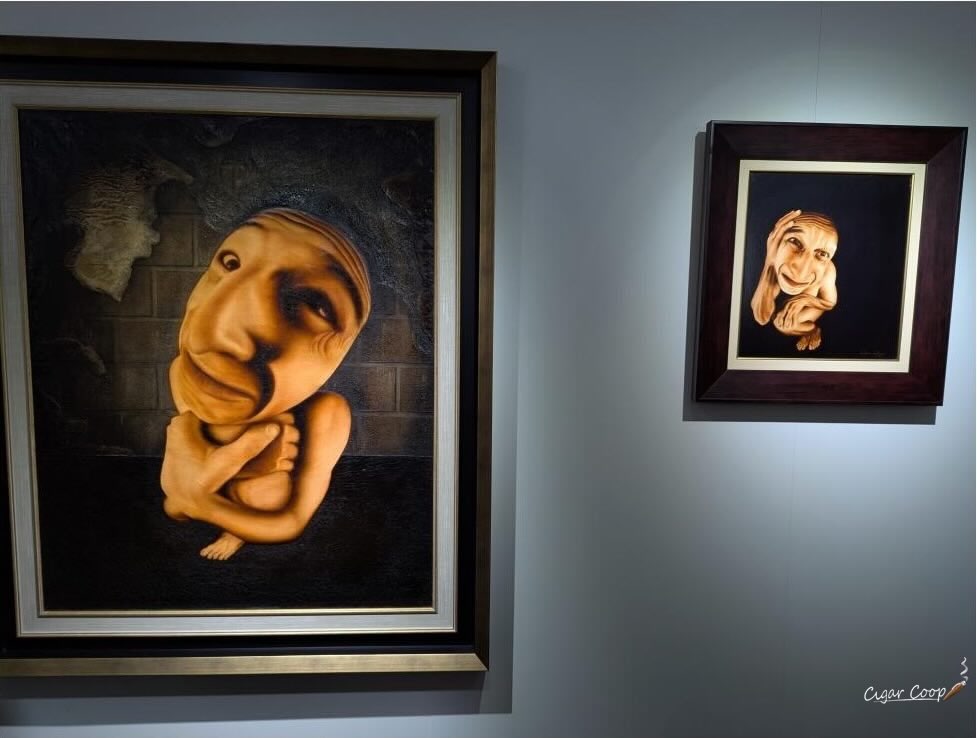
Finally, we were treated to a gallery of Nelson Alfonso’s paintings. The exhibit was called Oscura Realidad, meaning Dark Reality, and it was inspired by Nelson Alfonso’s time as a political prisoner in Cuba.
Over the years, Alfonso has shown in art throughout Europe, but the Dark Reality Series has never been publicly exhibited until now. Much has to do with the theme, which focuses on a man in a dark social circle, simply wasn’t going to be showcased in Cuba or around the Cuban circuit. Of the seventeen works in the series, only a few left the island, finding their way into prominent private collections in England, the Dominican Republic, Cuba, and the United States.

Now that he has fulfilled bringing his family back into the cigar business, we have been told the next chapter in Nelson Alfonso’s journey will be a return to his painting craft. In a way, Nelson Alfonso has now come full circle.
Closing Thoughts
Typically, when I go on a factory or production tour and then try to document it, I use a watch analogy. I’ll describe the watch, but I don’t want to go into too much detail about its inner workings. With the Selected Tobacco facility, that was a little harder. In this case, I needed to get into a little more detail than I would in a tour recap.
This isn’t a new process in terms of what Nelson Alfonso has been doing to make his cigars, but it is a new facility. It has all of the makings of a world-class facility. We’ve heard a lot about these processes Selected Tobacco is doing, but touring the facility gave me a whole new perspective.
In the next installment of this series, we will recap the Grand Opening gala event that factory tour guests attended.
Photo Credits: Cigar Coop
Travel, lodging and incidentals were paid by Cigar Coop for this trip