Although the cigar industry is quite small when compared to, say, the cell phone industry or the entertainment industry, there are always new companies entering the market that don’t make a splash at first. For me, EGM Cigars was one such company.
EGM actually started out as a Swiss retailer selling cigars, but the latest incarnation of the business is an actual cigar brand, not a store. The company is based in southern Switzerland, just north of the Italian border, and is led by Ettore Moraschinelli.
During the 2026 PCA Convention & Trade Show, EGM showed off its first maduro offering, carrying the appropriate name of EGM Maduro. Blend-wise, the regular production line is made with a Pennsylvania broadleaf wrapper covering a binder and filler tobaccos grown in the Dominican Republic. The cigars are made by José Matías Maragoto’s ABAM Cigars S.R.L, a factory in Santo Domingo, Dominican Republic.
The line launched with three different vitolas, each packaged in 10-count boxes:
- EGM Maduro Rios (6 x 46) — $29.99 (Box of 10, $299.99)
- EGM Maduro Floridos (5 1/2 x 52) — $34.99 (Box of 10, $349.99)
- EGM Maduro Maximos (5 1/4 x 56) — $36.99 (Box of 10, $369.99

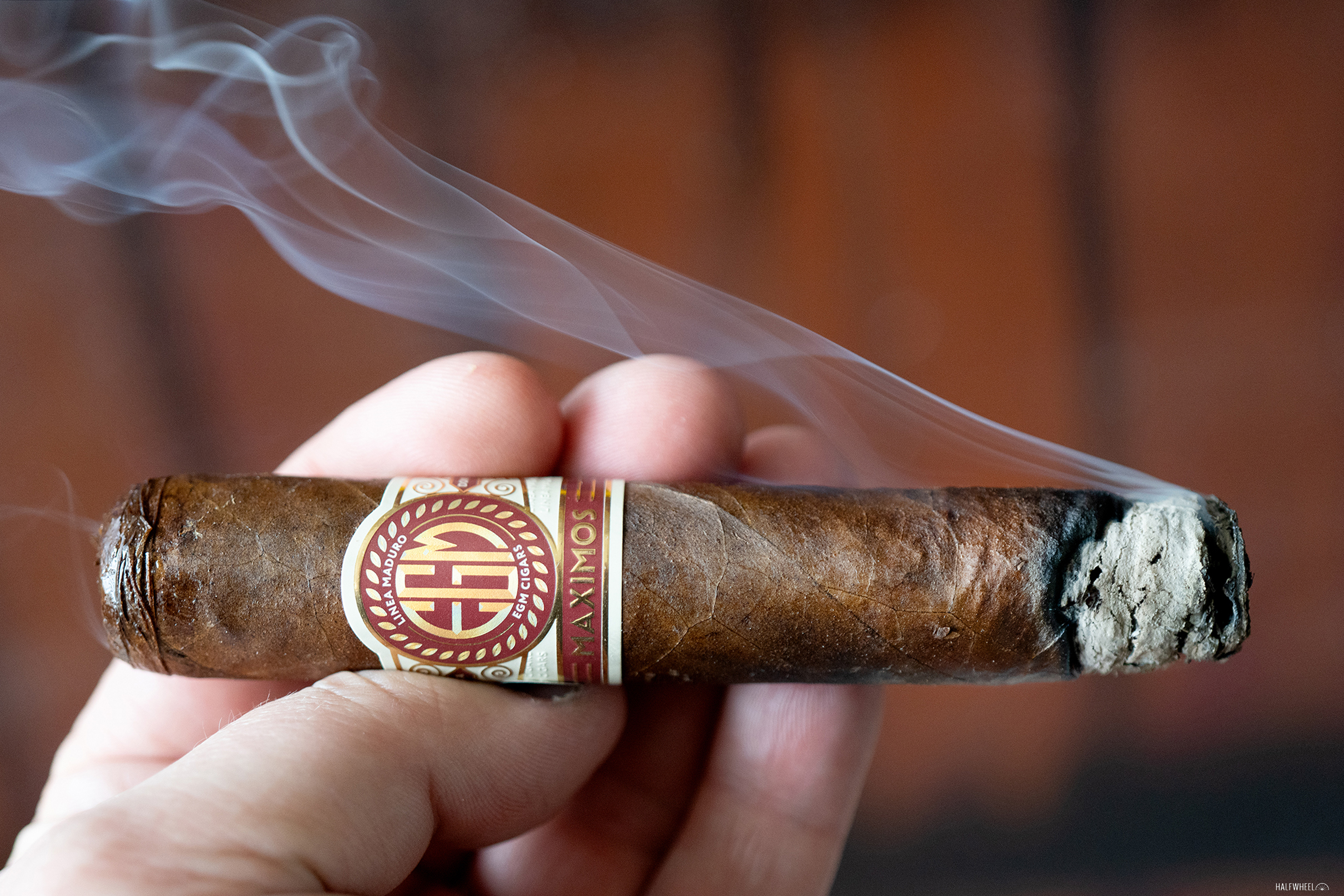
Dark, reddish-brown wrappers cover the three EGM Maduro Maximos cigars, and while all three cigars have similar protruding veins, only one has what looks to be a knot near its foot band, more in the Final Notes below. Those wrappers have some tooth to them, but each also has a noticeable amount of oil present, which makes them a bit slicker to the touch. Physical inspections reveal that two of the three cigars have large soft spots—albeit in different locations between the main band and the foot band—but the third cigar does not have one. The cigars are nicely firm when squeezed, but my first cigar feels noticeably lighter than the other two. Cinnamon and earth lead the aromas coming from the wrappers, followed by leather, breadiness, sweet barnyard, generic woodiness and dry straw. The scents from the feet are substantially more aggressive, with creamy oak and sweet apple juice over notes of mulch, lemongrass, cinnamon, cocoa nibs and light cloves. Aged oak and earth dominate the cold draws, followed by dark chocolate, nutmeg, herbs, starchy rice and a touch of floral sweetness.
All three cigars start off extremely smooth, with notes of white pepper and coffee beans that slowly transition to the main flavors of creamy oak and leather tack. Secondary flavors of toasted bread, powdery cocoa nibs, gritty earth and some generic but enjoyable nuttiness come and go, and, about halfway through the first third on two of the cigars, a light spice shows up on my tongue. The white pepper is also present on the retrohales, along with a small amount of honey sweetness, and the third cigar is stronger than the other two. There is also a touch of floral sweetness on the finish, but it is just not strong enough on any of the cigars to really impact the overall profile. Flavor ends the first third at medium-full, the body hits a point about halfway between mild and medium, and the strength makes it to just under the medium mark. Construction-wise, the second and third cigars each need a quick touch-up with my lighter to avoid larger issues, but the smoke production and draws are problem-free so far.

During the second third, the profiles diverge a bit: the first and second cigars continue with the same main flavors of leather tack and creamy oak that were present in the first third, while the third cigar features a new combination of toasted bread and creamy cashews. Additional flavors include nutmeg, gritty earth, dried tea leaves, charred meat, and barnyard, along with a touch more spice on my tongue that is now present on all three cigars. The flavors on the retrohale are also a bit different across all three cigars: the first cigar features white pepper and light vanilla ice cream sweetness, the second has white pepper and honey, and the third now exhibits more white pepper and light brown sugar. While the floral note has disappeared from the finish—replaced by a less engaging earthy flavor—just after the burn line passes the halfway point, a slight mineral salinity shows up on my lips for all three cigars, which seems to be getting stronger as the second third burns down. Flavor remains at medium-full for the first two cigars but bumps up to full for the third cigar, while the body and strength both meet up at a solid medium. The burn lines are a bit wonky on all three cigars, but none need correction, and there are no issues with smoke production or draw resistance.

A new combination of sourdough bread and creamy oak takes over the profiles of all three cigars, followed by secondary notes that include dry leaves, cashews, earth, coffee grounds and dark chocolate. The spice on my tongue and mineral salinity have increased slightly, and while the retrohales now feature similar notes of white pepper and honey sweetness, that combination is most distinct in the third cigar. Flavor is now at full for all three cigars, while the body remains at a solid medium and the strength manages to break into medium-plus territory. Two cigars need a couple of minor touch-ups with my lighter, but that’s the only construction issue.

Final Notes
- If the ABAM factory sounds familiar, it is probably best known for making cigars for another well-known Swiss cigar company: Villiger. It’s also an example of a Dominican cigar factory not located in Santiago, a relative rarity. Instead, it’s based in Santo Domingo.
- My colleague Patrick Lagreid reviewed another one of EGM’s cigars last week, the 7 x 34 Ninfa.
- EGM describes this blend as medium-full, but I would actually peg it closer to medium-plus.

- As I mentioned above, there was a massive protrusion on the wrapper of one of the cigars, and while it did not really affect the flavor or construction in any significant way that I could discern, it was extremely obvious when I first inspected the cigar.
- I found the final cigar to have the most complexity in its profile, mostly due to the combination of toasted bread and creamy cashew flavors in the second third that were missing in the other two cigars.
- The cigars for this review were purchased by halfwheel.

- These cigars are listed as being 5 1/4 x 54 vitolas. Above are the measurements we took when we measured them. As you can see, the second cigar was lighter in weight than the other two, so I was not surprised when it burned a bit faster.
- The final smoking time averaged out to one hour and 56 minutes for all three cigars.
- If you would like to purchase any of the EGM Maduro Maximos cigars, site sponsor Small Batch Cigar sells them on its website.
87
Overall Score
I had never heard of EGM Cigars before I photographed the company’s Ninfa release in the studio. I found the Maduro Maximos to be smooth, creamy and slightly sweet, with enough strength to enhance the experience but not even close to enough to cause issues with the overall balance. Having said that, each of the cigars needed at least one burn correction to stay on track, and I do wish there was more sweetness to go along with the overt creaminess in the profile. The price point is going to turn some people off, but I enjoyed the EGM Maduro Maximos more than enough to want to smoke other cigars in the company’s portfolio, something that is not always the case when discovering a new cigar company.
ABAM Cigars S.R.L
Dominican Republic
Double Robusto
EGM Cigars
EGM Maduro
EGM Maduro Maximos