ith its trickling fountain and cloistered courtyard, Plasencia Cigars S.A. in Nicaragua seems more like a monastery than a factory. Workers holding tobacco quietly walk from one end of the covered quadrangle to the other, sometimes in pairs, then disappear through a doorway. Somehow, all the noise of Estelí outside of these four walls has been neutralized.
It’s equally tranquil in the rolling gallery, where cigarmakers toil at every table as though they’ve taken a vow of silence. When Nestor Andrés Plasencia Jr. walks into the room, one roller notices, then another, and then another until the rustling of tobacco stops and suddenly, everyone is banging their metal chavetas against the table tops. It isn’t a form of protest or discord. It’s applause and one of the most endearing sounds anyone in the cigar industry can hope to hear.
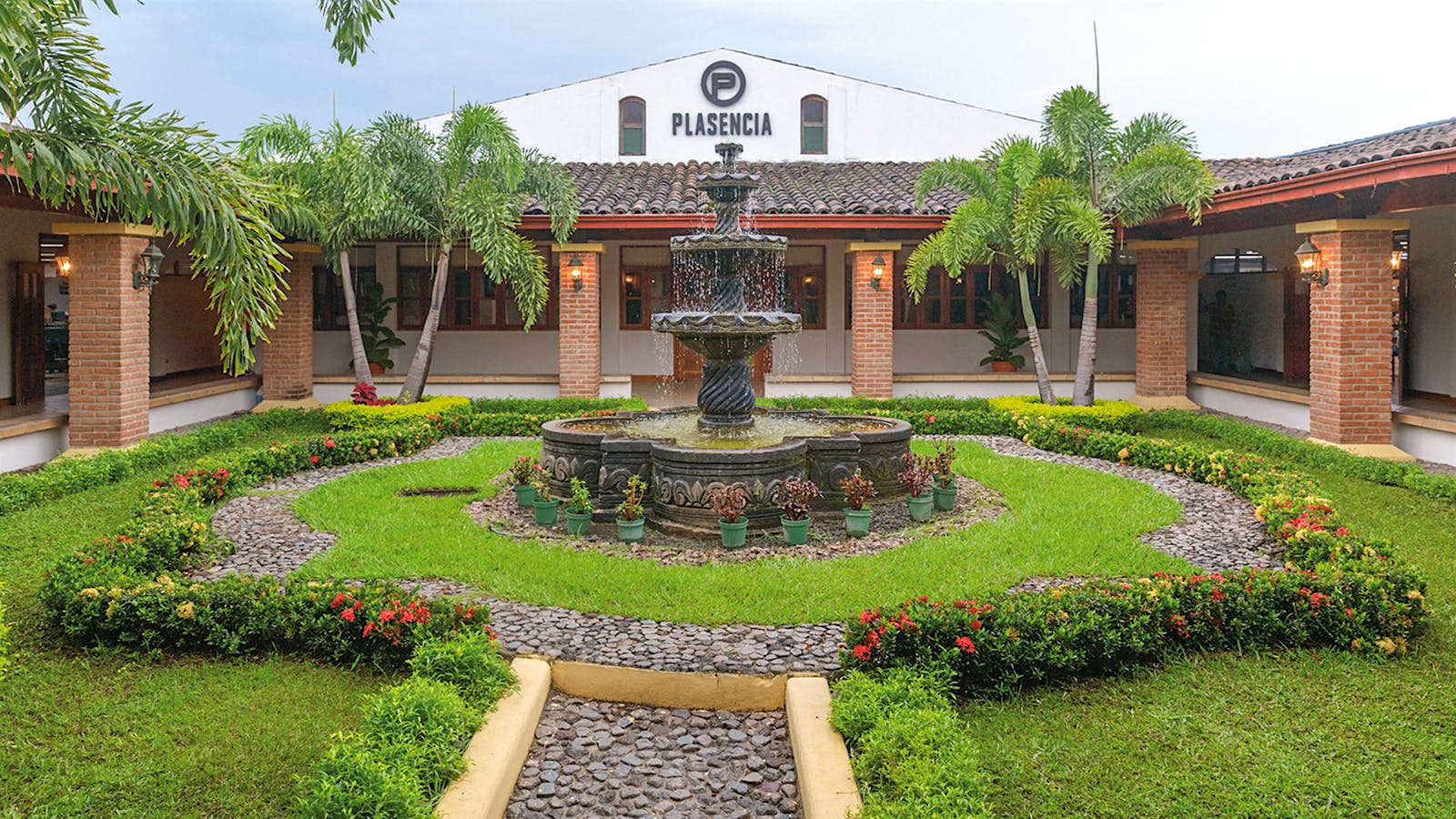
A fountain in the central courtyard of the Plasencia factory in Nicaragua brings a sense of calm to a very productive operation.
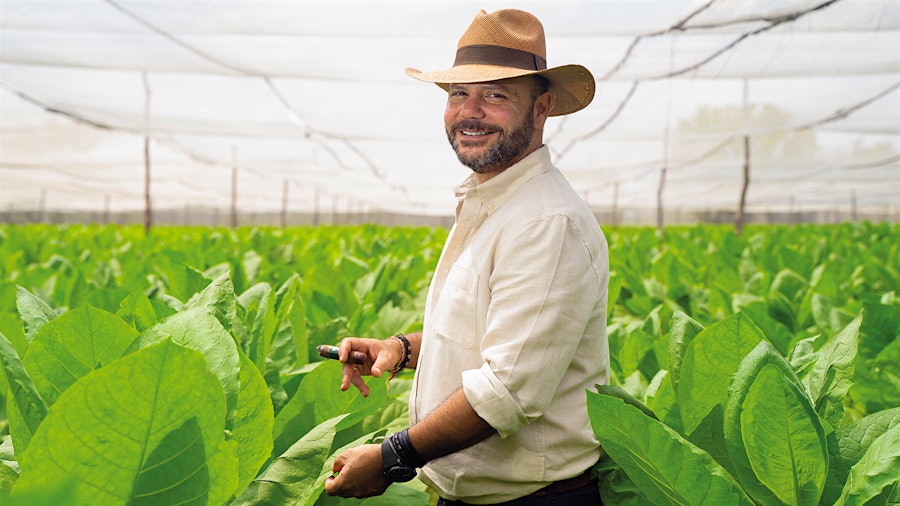
Wearing a woven Panama hat and close-cropped beard, Plasencia smiles and nods in appreciation before circulating around the room to inspect some cigars. Every boss wants to be loved and respected, and maybe even a little feared. Now 49 years old, Plasencia seems to have all three in the perfect amounts. His walk is far from menacing, but it’s certainly confident. This isn’t just Nestor Plasencia Sr.’s kid anymore, skipping around the factory like a carefree heir apparent. This is the man in charge.
“When I first started working, I had to earn the respect of the workers, so I had to wake up earlier than everyone,” Plasencia says after his inspections are over. He’s smoking a thick robusto and sipping a cafecito in a small lounge he built on the other side of the courtyard. “I didn’t want to impose my authority. It’s a moral authority. It was a process.”
If you smoke cigars, you’ve most likely smoked tobacco grown by the Plasencia family—whether you know it or not. The company is easily the largest grower of premium tobacco leaf in Central America and sells cigar tobacco to most of the major cigarmakers in the handmade sector. In addition to its massive growing and brokerage operation, Plasencia Cigars maintains factories in both Honduras and Nicaragua, producing more than 45 million cigars a year. Most of the cigars are for third-party companies, but a good number are Plasencia’s own brands. At the helm are Nestor and his father, Nestor Sr. The elder Plasencia shows little signs of slowing down, while the younger has done all he can to bring the company into the 21st century.
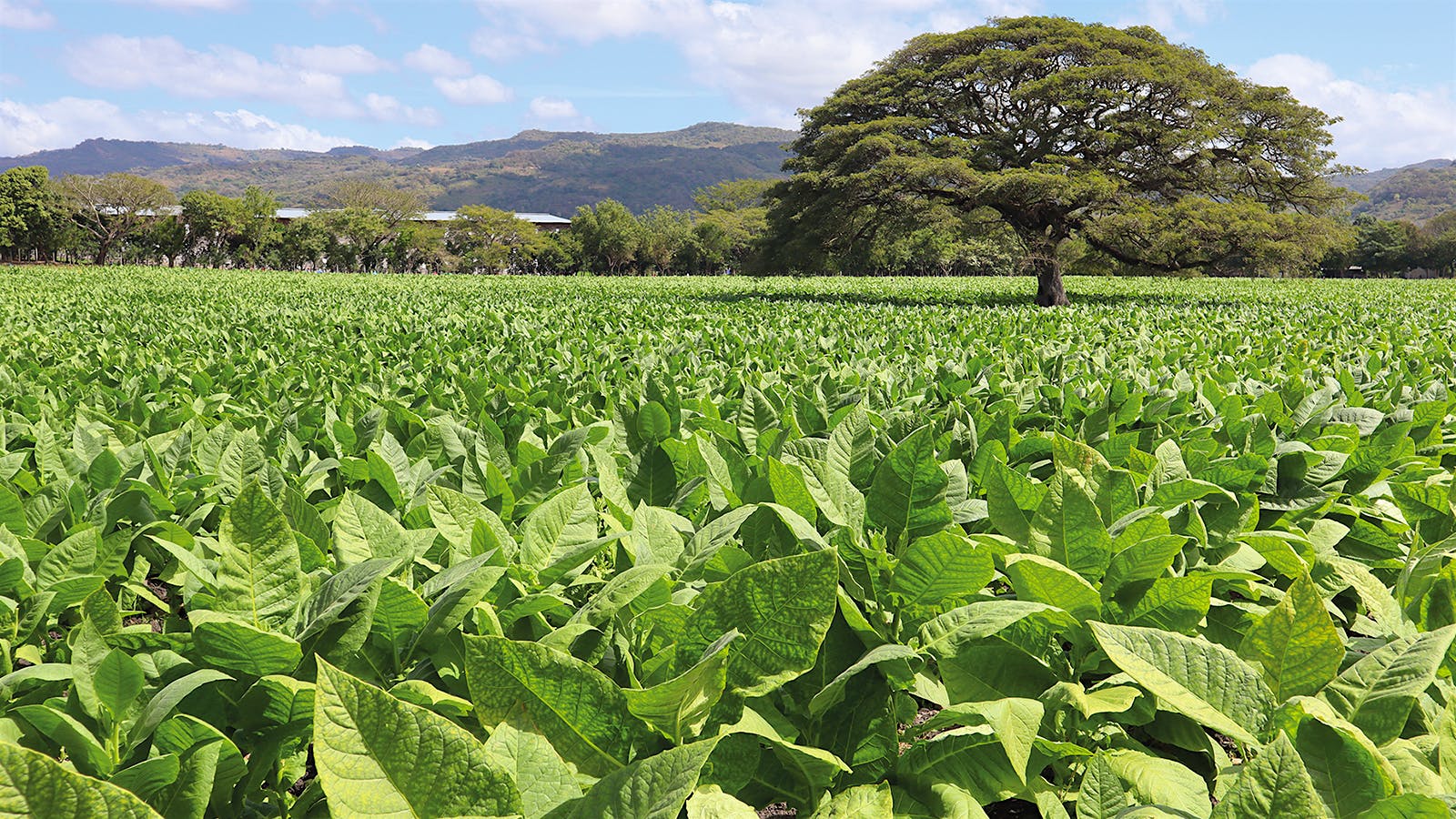
Acres of tobacco rustle in the wind at this farm in Estelí, Nicaragua, owned by the Plasencias, who’ve been growing tobacco since the 1800s.
“He’s the big boss in charge of everything. Everything,” Nestor Jr. says of his father with wide-eyed emphasis. “He’s going to be 75 this year. The energy that he still has—I get tired when I go with him to the farms. He’ll drive for two hours to one farm all in the same day.”
Nestor Jr. is a fifth-generation tobacco man who splits his time between Honduras and Nicaragua overseeing his family’s vast network of tobacco farms and cigar factories. Despite his huge responsibilities, he still shows deference to his father. This particular facility in Nicaragua, which produces about seven million cigars a year, is only a small part of Plasencia’s operation, but a very important one. It’s the home of his Alma Fuerte brand, the line that transformed him from a farmer who also happens to make cigars to a legitimate producer in the premium arena. Plasencia-branded cigars have scored in the 90s repeatedly, and have made several appearances on Cigar Aficionado’s Top 25 list.
Simply stated, nobody in Central America grows more tobacco for the premium cigar industry than the Plasencia family. By Plasencia’s estimation, his company supplies leaf to about 70 percent of the premium cigar industry. “All the big guys,” he says matter-of-factly. This includes Altadis U.S.A., Davidoff of Geneva and General Cigar Co. (which owns 20 percent of Plasencia’s company). On the production side, Plasencia not only has a portfolio of its own brands, but produces many third-party brands such as Alec Bradley, Ferio Tego, a few versions of Romeo y Julieta and, his biggest cigar client of all, Rocky Patel, who has some of his Honduran cigars rolled in a Plasencia factory.
Beauty is rarely a consideration when building a cigar factory. The goal is efficiency, not a spread in Architectural Digest, but the monastic feel of Plasencia Cigars in Estelí was by design.
“We built this together with Dannemann in 1996,” Nestor Jr. says, referring to the time when Dannemann, a European company known for machine-made smokes, wanted to get into the premium side of the business. The two companies partnered in a short-lived venture. “We used to sell tobacco to them. We made cigars for them too, so we built it together and we were going to make cigars for a distribution company that they had in the United States. Then they decided to get out of premium and focus on cigarillos, so we bought their part of the factory and took it over in the early 2000s.”
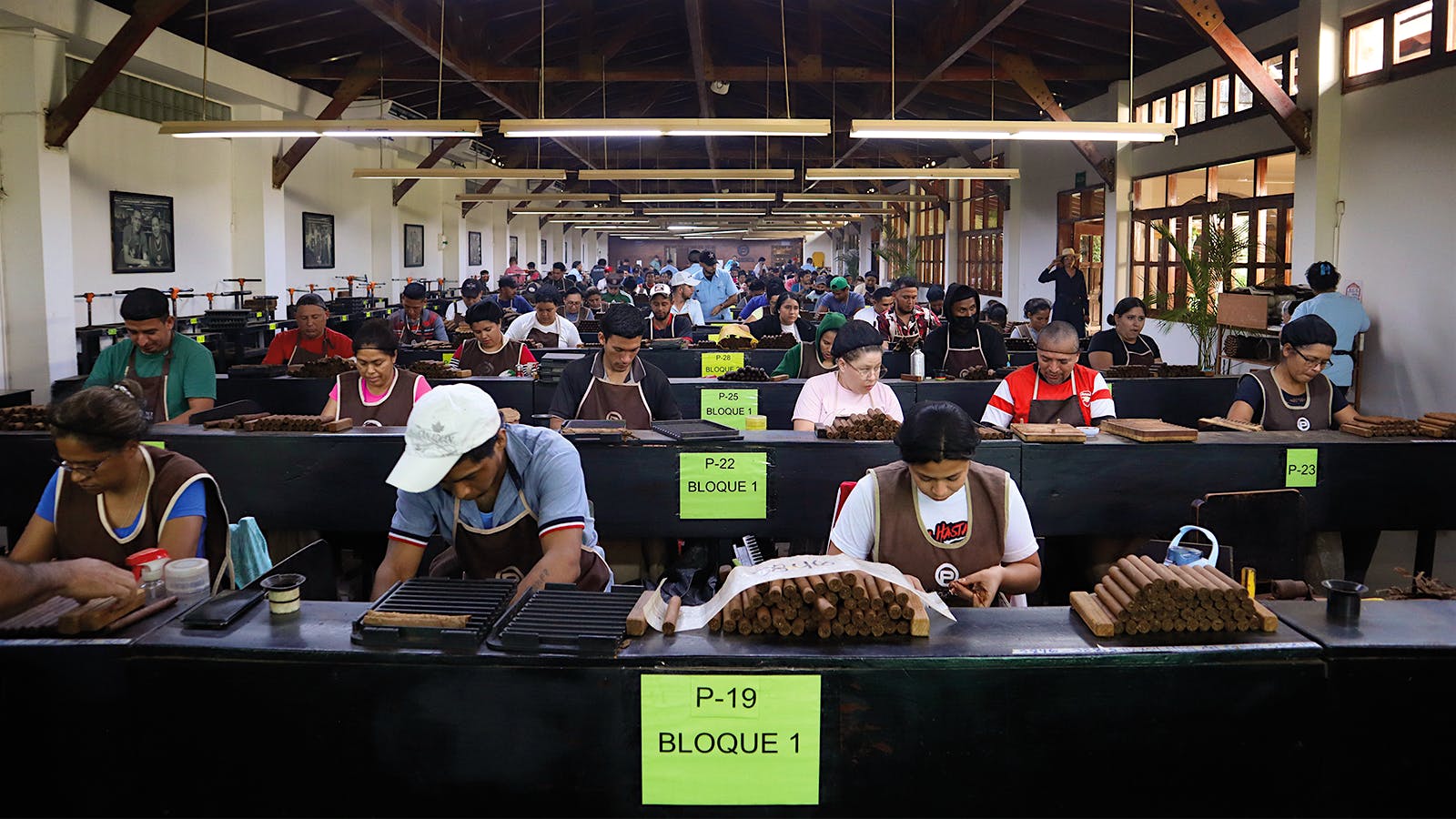
Rollers at the Plasencia factory are making flagship brands such as Alma Fuerte and Alma del Fuego.
The Plasencia story, of course, goes back much further. Like many tobacco growers in Central America and the Caribbean, the family legacy began in Cuba. According to the history, the Plasencias started producing tobacco in 1865, but they didn’t grow their first crop in Nicaragua until 100 years later. After fleeing Cuba in the 1960s when the Castro regime nationalized Cuba’s cigar and tobacco industries, Plasencia’s father, Nestor Sr., and his grandfather, Sixto, relocated to Central America. Like so many disenfranchised tobacco growers in Cuba, they were looking to start over. The story is almost biblical—an exodus and a genesis.
“We started two farms in Jalapa, one candela and something else Cuban seed,” he says of his family’s venture. Then, nationalization happened all over again, this time in Nicaragua. “The Sandinista government forced my father out so he started from scratch in Honduras. I love his determination and I respect that guy so much.”
When the Sandinista regime took over Nicaragua in 1979, it nationalized the agricultural industry and seized the country’s tobacco farms. Manufacturers could still produce cigars in Nicaragua but they couldn’t farm the land and were forced to purchase tobacco directly from the government, which concentrated on volume over quantity. Furthermore, an outbreak of blue mold laid waste to Nicaragua’s wrapper production. Things in Nicaragua were grim.
Familiar with revolutions and the ramifications of government takeovers, the Plasencias moved north to Honduras. Nestor Jr. was only three years old. Eventually, the tides turned in 1990 when the Sandinista government was voted out of office and Violeta Barrios de Chamorro was voted in.
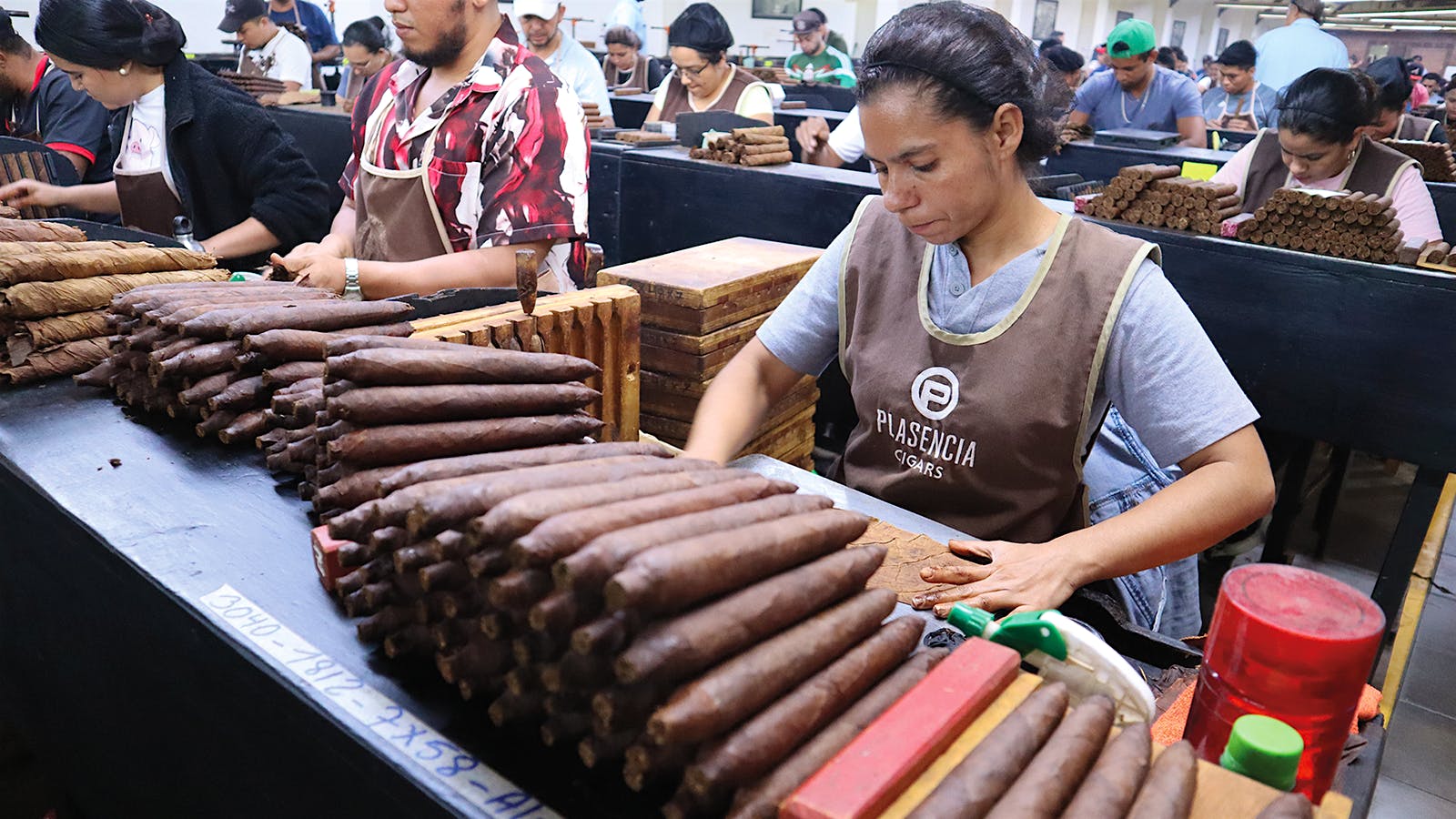
Surrounded by Salomones. It’s the most difficult size to make, but this roller has mastered the curves and tapers of the Plasencia Alma Fuerte Generacion V.
“When Chamorro won the elections, she needed some investors,” Nestor Jr. says. At the time, Nicaragua had amassed $12.5 billion in debt while only having a gross domestic product of $1.8 billion. “In 1992, a lot of people were reclaiming their land. The government was willing to give back some land in order to restart the economy. It was a long process, but we got 30 percent of it back. This was in Estelí.”
Though understandably a little suspicious of the new government, Plasencia’s father had enough incentive to start a Nicaraguan cigar factory in 1994 in Ocotál, but he still kept all the operations he’d established in Honduras.
“He wanted to diversify so that all his eggs were not in one basket,” Nestor Jr. says. “The factory made mostly private labels. He also subsidized farmers—we’d give technical assistance and then buy the crop. Mostly sun-grown tobacco.”
Nestor Jr. knew from childhood that he’d be joining his father in the tobacco business. First, he graduated from the Zamorano Pan-American Agricultural School in Honduras in 1998. Then, he went to work with the family business immediately after. Today, the Plasencias grow more than 4,000 acres of tobacco in Nicaragua and Honduras. They plant a variety of strains such as Corojo, and even some Connecticut shade, but the majority is a Criollo hybrid they developed, simply referred to as Havana.
“It’s a phenotype that we like,” he explains. “We crossed it with Criollo ’92 and Corojo. We look for disease resistance and a leaf that can adapt to climate. We use a slightly different type in Jalapa because the climate is different. The idea is to put the seeds where they’re most comfortable.”