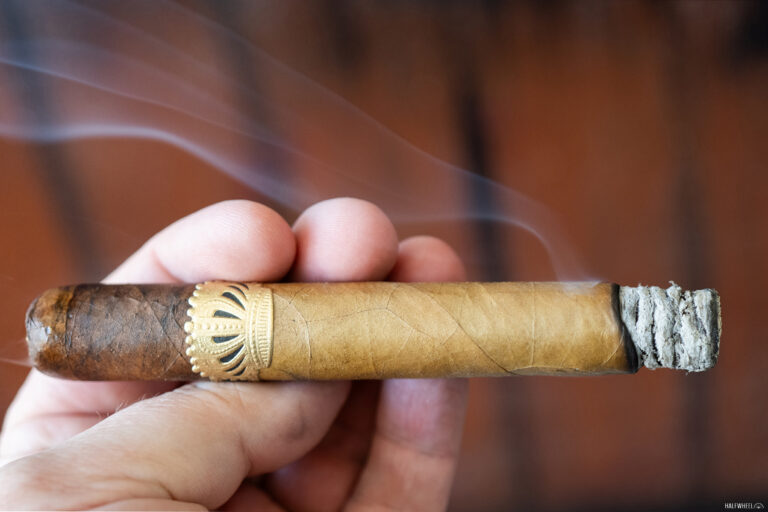
During the 2026 PCA Convention & Trade Show, Dunbarton Tobacco & Trust showed off an offshoot to its Sobremesa line with a very distinctive visual look: dark tobacco on top—covering the cap and about an inch below that—with a lighter wrapper flowing from where that tobacco ends to the foot of the cigar. The name of the line is Tapa Negra—which means “black lid” in Spanish—and if it looks a bit familiar, that may be because the same design is used by Joya de Nicaragua’s Cabinetta line.
Steve Saka, founder of Dunbarton Tobacco & Trust, previously worked at JR Cigar and Drew Estate, both of which play a role in the Tapa Negra’s origins.
“This is a technique I first became exposed to when I worked with Lew Rothman (at JR Cigar) in the late 90’s with a brand called La Escepción,” said Steve Saka, founder of Dunbarton Tobacco & Trust, in a post on his Facebook page. “I then shared the idea with my factory partners at Joya de Nicaragua and they created their Cabinetta line. What I love about this technique is how it affects the smoking experience – the cigar’s smoke remains creamy and smooth, but the spicy Nicaraguan Sun-Grown capa being in contact with your palate adds great pepper notes, but allows the cigar to remain a very relaxing, mild smoking experience.”
During his time at Drew Estate, the company was managing Joya de Nicaragua’s distribution in the U.S., which is when the dual wrapper Joya de Nicaragua Cabinetta line came to be.

Fast forwarding to 2026, Saka has now created his own version of the concept, which is made by Joya de Nicaragua. In terms of blend, the Sobremesa Tapa Negra is very similar to Dunbarton’s regular Sobremesa Brûlée line, meaning it uses an Ecuadorian Connecticut-seed G2BW wrapper covering a Mexican Matacapan negro de temporal binder, and Nicaraguan fillers: Condega C-SG, Pueblo Nuevo criollo, La Joya Estelí C-98 and ASP Estelí hybrid ligero. However, the top of the cigar—the cap and about an inch or so more—features a Nicaraguan sun-grown wrapper.
So far, there are only two different vitolas in the line, each packaged in 13-count boxes:
- Sobremesa Tapa Negra Corona Gorda (5 5/8 x 48) — $16.25 (Box of 13, $211.30)
- Sobremesa Tapa Negra Toro (6 x 52) — $16.95 (Box of 13, $220.30)

- Cigar Reviewed: Sobremesa Tapa Negra Corona Gorda
- Country of Origin: Nicaragua
- Factory: Fábrica de Tabacos Joya de Nicaragua S.A.
- Wrapper: Ecuador (Connecticut-seed G2BW) & Nicaragua (Sun-grown Cuban-seed)
- Binder: Mexico (Matacapan Negro de Temporal)
- Filler: Nicaragua (ASP Estelí Hybrid Ligero, Condega C-SG, La Joya Estelí C-98 & Pueblo Nuevo Criollo)
- Length: 5 5/8 Inches
- Ring Gauge: 48
- Shape: Round
- MSRP: $16.25 (Box of 13, $211.30)
- Release Date: June 22, 2026
- Number of Cigars Released: Regular Production
- Number of Cigars Smoked For Review: 3
Like the Cabinetta, the contrast between the lighter golden-brown color and the almost purple-brown darker wrapper is extremely easy to see at first glance. Those differences extend to the physical aspects of the two wrappers as well: the lighter wrapper is silky-smooth to the touch, while the darker wrapper is significantly rougher and has a bit more oil. The cigars are firm when squeezed and while there are veins present on all three cigars, they are very thin and almost perfectly flat. A distinct mint leaf note leads the aromas coming from the wrappers, followed by sweet woodiness, barnyard, coffee beans, baker’s spices, and some light breadiness. Scents from the feet are nuttier and creamier overall, with white pepper, earth, sweet bread, leather tack and a light wax note. After straight cuts, the cold draws are surprisingly sparse when it comes to flavors, with generic nuttiness, earth, sweet tobacco, white pepper, cinnamon and some more light breadiness.
All three cigars start out with a similar profile of cedar, light pepper and a punch of spice on my lips and tongue, although the first cigar has the most spice while the third cigar has the least. That spiciness carries over and becomes one of the strongest flavors, alongside creamy hay and roasted peanuts. Milder flavors of coffee grounds, dry earth, herbs, white bread and dark chocolate flit in and out, and while the spice on my lips is getting stronger for the first two cigars, it is fading fast on the third cigar. The retrohales feature a combination of honey sweetness and white pepper, but in different amounts: more pepper in the first and third cigars, more honey sweetness in the second cigar. However, the finish for all three cigars has the same earthy undertone. Flavor ends the first third at full, the body is halfway between mild and medium, and the strength is slightly below the medium mark. There are zero construction issues so far.

The second third sees a major uptick in the flavor profiles of the three cigars, as a combination of pecans and creamy cedar land at the top spot, followed by additional flavors of espresso, straw, cocoa nibs, buttered bread and a light floral note. Earth is still very much present on the finish of all three cigars, but it is less distinct on the second cigar and strongest on the third cigar. The retrohales are still full of a combination of white pepper and honey sweetness, but it is stronger on all three cigars than it was in the first third. The flavor remains at full, the body stays at a point between mild and medium and the strength has not budged from its place just below the medium mark. Unfortunately, two of the three cigars developed burn issues that require correction with my lighter, but those are the only construction problems.

As the burn line reaches the start of the final third, the profiles are very consistent with what I noted in the second third: main flavors of pecans and creamy cedar, followed by creamy hay, gritty earth, peanut butter, salted potato chips, and charred meat. There is a new lemongrass flavor on the finish for the second and third cigars, but the first cigar lacks it completely. The retrohale continues to have an abundance of white pepper, and while I am also tasting a distinct honey sweetness, at about the same level as the second third. Flavor ends at full, the body ends just under medium and the strength hits a solid medium, but barely.

Final Notes
- I absolutely love the visual contrast between the (much) darker tobacco on the top of the cigar and the lighter, golden-brown shade on the bottom, and the metallic-brass embossed Dunbarton Tobacco & Trust logo on the band only accentuates that contrast.
- The cigars are rolled with the Connecticut-seed wrapper running the full length of the cigar. The darker Nicaraguan wrapper is then added to the top, meaning there are two wrappers for the top section but one for the bottom of the cigar.
- During my meeting with him at the 2026 PCA Convention & Trade Show, Saka mentioned that the Nicaraguan wrapper used on the cap of these cigars gives the smoker a bit of spice on the lips when smoking it. In fact, I did find a bit of a zing, but it is far from strong enough to be a nuisance in any way.

- The first cigar ended up having three different colors of wrappers. A much lighter piece of tobacco was used for part of the cap.
- While I have not smoked one in quite a while, I always enjoyed smoking the Cabinetta Lancero, and was a bit disappointed that there is not a lancero vitola in this line. Yet.

- Speaking of the Cabinetta, here are the two cigars side-by-side.
- Dunbarton Tobacco & Trust advertises on halfwheel.
- The cigars for this review were purchased by halfwheel.

- These cigars are listed as being 5 5/8 x 48 vitolas. Above are the measurements we took when we measured them. Both the weight and ring gauge difference on the last cigar were very apparent when it was compared to the other two cigars.
- The final smoking time averaged out to one hour and 56 minutes for all three cigars.
- If you would like to purchase any of the Sobremesa Tapa Negra Corona Gorda cigars, site sponsors Atlantic Cigar Co., Cigars Daily, Corona Cigar Co., JR Cigars and Small Batch Cigar sell them on their respective websites.
87
Overall Score
I am a big fan of Dunbarton Tobacco & Trust’s Brûlée line—and even more of a fan of the Brûlée Blue—so I have been looking forward to trying the Sobremesa Tapa Negra since I heard about it. Not surprisingly, I found that the Tapa Negra has quite a bit in common with the Brûlée blend, including a profile full of strong and creamy nuttiness—both pecans and peanuts—as well as breadiness, cedar and some light but distinct honey sweetness on the retrohale. However, there are also some differences, including a tart lemongrass note on the finish and more pepper overall than I have found in any of the Brûlée cigars I have smoked. Then, there is the addition of the Nicaraguan sun-grown wrapper at the top, which adds an explosion of spice along with new flavors of charred meat, dry earth and dark berry sweetness. After smoking three of the Tapa Negra Corona Gordas for this review, I actually wish the darker wrapper came down to the halfway mark so that I did not have to wait as long to get to that flavor profile, but even so, this is a wonderful blend that just about anyone looking for a full-flavored blend should love.
Dunbarton Tobacco & Trust
Fábrica de Tabacos Joya de Nicaragua S.A.
SOBREMESA
Sobremesa Tapa Negra
Sobremesa Tapa Negra Corona Gorda