
Today, we are reviewing the Plasencia El Año del Caballo cigar. The name, which translates from Spanish to “Year of the Horse,” signifies Plasencia’s contribution to the 2026 Chinese New Year releases. Over the years, the market for Chinese New Year cigars has expanded significantly, peaking in 2024 with the Year of the Dragon. As a result, many companies are striving to differentiate their releases from one another.
This cigar features a unique tail attached to the cap. The tail is braided and made from tobacco, making it more artisanal compared to other caps. Plasencia has noted that it takes a team of three people to assemble these cigars: a master buncher, a roller, and a braider. The entire process takes twice as long as that of a standard cigar and requires precise humidity control to maintain the structural integrity of the cap. Each braid is sealed with a dual pañuelo wrap, preserving this heirloom-quality finish.
Meanwhile, if you are keeping score at home, there have been six Chinese New Year releases by Plasencia to date:
SPECIFICATIONS
Blend and Origin
El Año del Caballo uses a Nicaraguan wrapper grown organically in the Jalapa region, over a Nicaraguan binder. The fillers combine Honduran and Nicaraguan tobacco. The Plasencia family grew and aged all the tobaccos in the blend.
- Wrapper: Nicaraguan (Jalapa)
- Binder: Nicaraguan
- Filler: Nicaraguan, Honduran
- Country of Origin: Nicaragua
- Factory: Plasencia Cigars S.A.
Vitolas Available
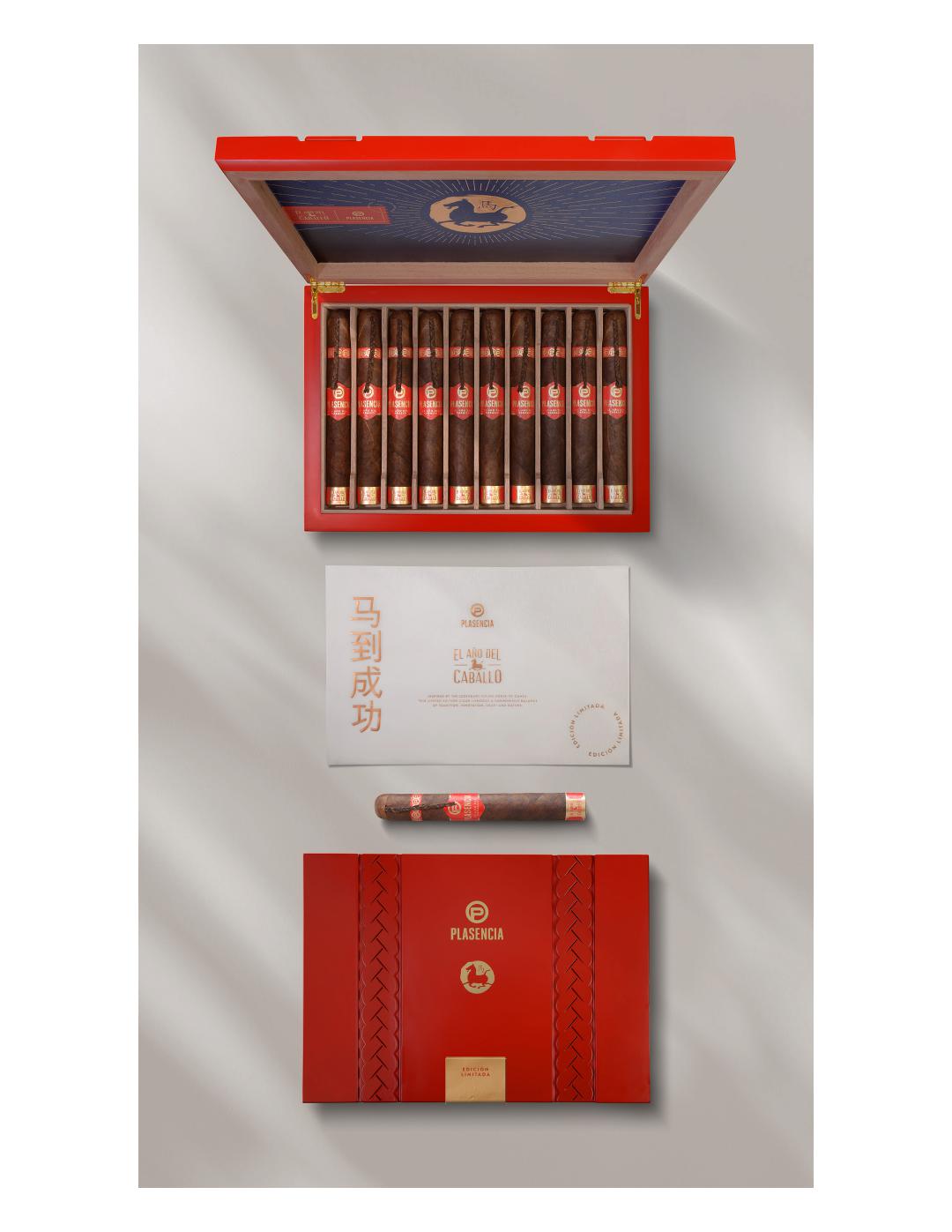
El Año del Caballo comes in one size – a 7 x 58 vitolas known as Parejo Gordo. A total of 6,000 ten-count boxes of the El Año del Caballo were produced.
Appearance (*)
The Nicaraguan wrapper on El Año del Caballo combines roasted coffee bean and mahogany tones. This wrapper was on the oily side. Upon examining the wrapper, some mottling was visible on the surface. Visible veins and wrapper seams were also present.
The braid is pretty impressive. This is quite intricate. It is attached to the lower part of the cap leaf. Since it is only affixed to the cap, not the whole side of the cigar, I was amazed the braid did not fall off in the samples I smoked.
PERFORMANCE
Pre-Light Draw (*)
Before lighting up El Año del Caballo, I used a straight cut to remove the cap. I did not cut off or remove the braid on each sample smoked. It is hard to say whether I made the right call, but I felt leaving it on was part of the cigar’s identity. I also removed the footer band.
Once the cap and footer band were removed, it was time for the pre-light draw. It had a mix of natural tobacco, earth, and subtle cherry sweetness. Overall, this was a satisfactory pre-light draw experience. At this point, it was time to toast up the footer of the El Año del Caballo and see what the smoking phase would deliver.
Tasting Notes
El Año del Caballo opened up with more notes of earth, natural tobacco, and cherry sweetness. It also had notes of baker’s spice and mixed pepper. For the first 3/4 inches of the cigar experience, there wasn’t really a dominant note. By then, the natural tobacco took over as the primary note, skewed toward a sweet (not artificial) flavor. Meanwhile, the earth, cherry, baker’s spice, and pepper remained secondary. On the retro-hale, an additional layer of black pepper emerged.
By the end of the first third of El Año del Caballo, the earth notes joined the natural tobacco notes in the forefoot. During this phase, as the natural tobacco notes developed, some bitterness emerged. In the background, the cherry, baker’s spice, and pepper remained secondary, but the pepper notes increased.
By the last third, the natural tobacco was definitely on the bitter side. It remained primary with the earth. The good news is this wasn’t a harsh bitterness. Meanwhile, the cherry, baker’s spice, and pepper remained secondary. The pepper no longer increased in intensity. This is the way El Año del Caballo came to a close. The resulting nub was soft to the touch and cool in temperature.
Burn
El Año del Caballo had a good burn, not a great burn. The burn path meandered, and the burn line was uneven. This required many touchups to keep things on track. The ash wasn’t overly loose, but it wasn’t firm either. The ash was mostly medium gray. Meanwhile, the burn rate and burn temperature were both ideal.

I opted not to burn the braid. Mostly because it wasn’t fully affixed to the wrapper, and I didn’t think it would help here. It was a bit of a nuisance.
Draw
El Año del Caballo’s draw performed quite well. It had a touch of resistance to it – which is a good thing. Sometimes this can be a negative on a longer (7-inch) cigar, but there were no issues here.
Strength and Body
El Año del Caballo is a cigar that delivered a medium-strength, medium to full-bodied smoking experience from start to finish. I didn’t notice any considerable increase in strength or body along the way. In terms of strength versus body, the body maintained a slight edge.
BANDING AND PACKAGING NOTES (*)
El Año del Caballo might be remembered as one of the last Plasencia releases to use the “P” logo bands, as the company has recently adopted a new logo. Plasencia is also one of the few companies to release a cigar where the primary band is not the top band. Like several other Plasencia releases, there is a secondary band above it. It also has a footer band. The primary and top secondary band are red with gold font. The secondary band is gold with red font. In general, the red and gold are no surprise given this is a Chinese Zodiac release
I also noticed the primary band is closer to the middle of the cigar. This is also an unusual move, but I think it lets the main band stand out, since the braid attached to the cigar will not completely cover it.

OVERALL ASSESSMENT
Final Thoughts
El Año del Caballo started out well – there was a nice assortment of flavors, and the flavors were well balanced. As the cigar experience progressed, things began to deteriorate. This included the emergence of bitter notes and a nuisance of a burn. While the flavors never got harsh, the cigar’s balance skewed toward the bitter side. In the end, this isn’t fun on any cigar, but it seems worse with a longer cigar. I applaud Plasencia for its craftsmanship; that won’t score it performance points. In the end, at $59.99, this is a cigar I would not splurge on. Even at a much lower price point, it’s also one I don’t see myself coming back to.
Summary
- Key Flavors: Natural Tobacco, Cherry, Baker’s Spice, Earth, Pepper
- Burn: Fair
- Draw: Excellent
- Complexity: Medium
- Strength: Medium to Full
- Body: Medium to Full
- Finish: Fair
Rating
Value: Don’t Splurge
Score: 86
REFERENCES
Photo Credits: Cigar Coop, except where noted.
(*) Indicates this is not factored into the score or value rating