Earlier this year, Blackbird Cigar Co. announced it would commemorate its 10th anniversary by releasing three cigars, each honoring the brand’s legacy and the people who have made it possible. The first release is named Pura Raza de Quisqueya, and it was created to honor the Blackbird’s master blender, who is known as Papo “El Caballo.”
The Pura Raza de Quisquya is a 6 x 52 box-pressed toro made with an Ecuadorian wrapper over an undisclosed binder and filler. The cigars are being made at the company’s factory, Tabacalera Robles, in Tamboril, Dominican Republic.

For 2026, Production is limited to 500 boxes of 10 cigars, and pricing is set at $16 per cigar. Jonas Santana, ceo and co-founder of Blackbird Cigar Co., said that Pura Raza de Quisqueya will be released annually in limited quantities, which will make each release “truly special and exclusive.”
“For over a decade, Papo ‘El Caballo’ has embodied the spirit of dedication and excellence,” the company said in a press release. “His tireless work ethic, often seen in the factory seven days a week, throughout the entire year, reflects a level of passion that transcends craftsmanship and enters the realm of artistry. Every blend he has touched carries his signature discipline, intuition, and love for the tobacco. This release stands as a heartfelt expression of gratitude for his invaluable contribution to Blackbird’s story.”

- Cigar Reviewed: Blackbird Pura Raza de Quisqueya
- Country of Origin: Dominican Republic
- Factory: Tabacalera Robles
- Wrapper: Ecuador (Connecticut-seed)
- Binder: Undisclosed
- Filler: Undisclosed
- Length: 6 Inches
- Ring Gauge: 52
- Shape: Pressed
- MSRP: $16 (Box of 10, $160)
- Release Date: April 2026
- Number of Cigars Released: 500 Boxes of 10 Cigars (5,000 Total Cigars)
- Number of Cigars Smoked For Review: 3
The first thing I notice about the Blackbird Pura Raza de Quisquya cigars is the dullish, light brown wrapper that covers each one. Once I pick the cigars up, I find the cigars not as heavy as I would have expected. The wrappers are smooth to the touch, a fact further accentuated by the fact that all the veins are completely flat. When squeezed, each cigar has some firmness, which makes it that much easier to find a small soft spot just under the band on the first and third cigars. A combination of sweet hay and barnyard leads the aromas coming from the wrappers, followed by coffee grounds, woodiness, earth and white pepper. Nutmeg is the main note emanating from the feet, along with some generic nuttiness, creamy leather, baker’s spices, earth and vanilla beans. After straight cuts, the cold draws bring flavors of oak, leather tack, sweet breadiness, dry hay, earth and light milk chocolate.
Each cigar starts out mild with just a little white pepper and a sawdust flavor that quickly morphs into a main combination of dry hay and creamy oak. At various points, secondary flavors of toasted bread, herbs, pencil lead, terroir and leather show up, while the retrohale features some light white pepper and honey sweetness. The first and third cigars have an interesting flavor on the finish that reminds me of suntan lotion—it is not as bad as it sounds—while the second cigar features a more generic earth note. Flavor ends the first third at medium-full, while both the body and strength hit a point halfway between mild and medium. The burn line is all over the place, leading to corrections from my lighter on the first and third cigars, and the ash on two of the cigars flowers out a bit, more on that in the Final Notes below. However, the draws are giving excellent resistance, and there is no dearth of thick smoke coming from the feet.

There are not many changes in the second third. The main flavors remain the same combination of creamy oak and dry hay, followed by additional notes of leather tack, gritty earth, herbs, toasted bread, and light coffee beans. The white pepper and honey sweetness continue to dominate the retrohales, although the first cigar has a bit more pepper and the second cigar features a bit more of the sweetness. Another change is in the finish, as a light floral note takes over for all three cigars, though it is more distinct on the second cigar. Flavor stays medium-full, and the body remains between mild and medium, but the strength increases enough to move closer to the medium mark. Once again, the first and third cigars need attention from my lighter to stay on track, but the draws and smoke production are still issue-free.

The main flavors change a bit, as the toasted bread flavor joins the oak at the top of the profile for the second and third cigar, while the first cigar sticks with a much less distinct oak and dry hay combination that has become almost boring. Secondary notes include coffee beans, gritty earth, cinnamon, roasted peanuts, and dry leaves, while the combination of white pepper and honey remains firmly in place on the retrohale of all three cigars, albeit less so on the first cigar. One change is on the finish, where each cigar now has a different flavor: plain earth on the first cigar, cinnamon on the second cigar and cocoa nibs on the last cigar. Flavor bumps up to full for the second and third cigars—the first cigar stays at medium-full—and the body increases enough to land just south of medium, while the strength manages to cross into solid medium territory. Thankfully, only one cigar needs a quick burn correction in this third, but the draws and smoke production continue to give me no problems at all.

Final Notes
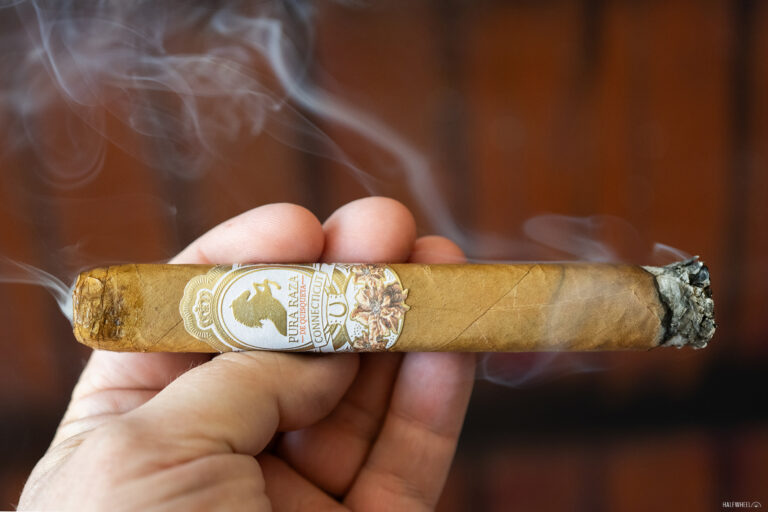
- If you are wondering why there’s a horse on the band. Pura Raza de Quisqueya translates to “purebred of Quisqueya.” Quisqueya is located in the southeastern part of the Dominican Republic.
- Blackbird describes Papo as “the man whose hands and heart helped shape the very foundation of Blackbird.”
- While there will eventually be three separate releases commemorating Blackbird’s 10th anniversary, the company has not yet announced a timeline for the other two limited editions.

- The ash flowered out in my first and third cigar, as you can see in the photograph above. Interestingly, this never happened in the second cigar, and it never occurred again in either cigar after the initial problem.
- Speaking of the ash, it is extremely flaky and falls in small chunks—usually at the most inconvenient times—something to be aware of if you are smoking over a laptop or book.
- The cigars for this review were purchased by halfwheel.

- These cigars are listed as being 6 x 52 vitolas. Above are the measurements we took when we measured them.
- The final smoking time averaged out to one hour and 47 minutes for all three cigars.
- If you would like to purchase any of the Blackbird Pura Raza de Quisquya cigars, site sponsor Atlantic Cigar Co. sells them on its website.
86
Overall Score
There is a very good reason we smoke three of every cigar for our reviews: if I had stopped after the first Blackbird Pura Raza de Quisquya, I would have walked away with a much different opinion. That is because the first cigar was so problematic on multiple levels: the flavors were not as distinct as the other two—especially in the final third—and the construction left quite a bit to be desired. Thankfully, the last two cigars were quite a bit better in every way, and I am looking forward to seeing what Blackbird has in store for the remaining cigars being released for the company’s anniversary.
Blackbird Cigar Co.
Blackbird Pura Raza de Quisqueya
Dominican Republic
Papo “El Caballo”
Tabacalera Robles
Toro