
During my travels, I always keep a close eye on the local cigar scene, documenting my experiences in my “In My Mind’s Eye” series. My recent trip to Denver, Colorado, was a bit different. While I aimed to explore the area’s history and culture, which included a visit with my longtime friends at Cigar Dojo, my most significant inspiration came from an unexpected source: the History Colorado Center. This fascinating museum tells the story of the state, and I discovered that tobacco plays a key role in reflecting Colorado’s rich history.
History Canceled
Reflecting on history and how the History Colorado Center embraced tobacco culture reminds me of a discussion we had with Drew Newman from J.C. Newman Cigar Company. J.C. Newman has a deep connection to the history of Tampa, which is famously known as “The Cigar City.” At one point, Ybor City in Tampa was a hub for the cigar industry, home to many cigar factories. Between 1919 and 1954, there were several iterations of a minor league baseball team called the Tampa Smokers, named after the significant role that the cigar industry played in Tampa’s identity. Unfortunately, like many cigar factories in the area (excluding J.C. Newman), the Smokers eventually disbanded. Recently, J.C. Newman introduced a Tampa Smokers cigar to honor the legacy of the team.
In the conversation with Drew Newman, we talked about how the major league team, the Tampa Bay Rays, decided to wear Tampa Smokers jerseys as a tribute to the team. However, they chose a “contemporary” version of the jersey that removed the cigar the players had worn. While walking through the exhibits at the History Colorado Center, I was struck by how easy it would have been to gloss over the tobacco culture. However, they chose not to do that.
History Colorado Exhibits Keeping Tobacco Culture Alive
Three items showcased tobacco culture
- Matchbooks and ashtrays from the businesses of Colfax Avenue
- Cigars sold at mercantile stores in Old Denver
- Cigar boxes as a part of the display of Camp Amache
Colfax Avenue

Colfax Avenue runs east-west through the Denver metropolitan area. At 49 1/2 miles, it is said to be the longest continuous commercial street in the United States. It is part of US Highway 40, a transcontinental road. Colfax Avenue can be traced back to the pioneer days, and some say the dinosaurs traversed it too. When U.S. Highway 40 was established in 1926, it spanned from Atlantic City, New Jersey, to San Francisco, California (today the road goes to Utah). Given this road ran through the growing Denver metropolitan area, for the next 40 years Colfax Avenue became a hub for businesses and tourist attractions. This included hotels, restaurants, commercial shopping, amusement parks, and nightlife.

The emergence of these businesses led to various artifacts in the mid-20th century. Many of these artifacts, including menus, ashtrays, matchbooks, and signs, were often overlooked.

While I loved seeing the ashtrays, the matchbooks really caught my attention. The matchbooks, ashtrays, and all of the other documents served as a great way of documenting the history of this area.

In this video, I walk through the matchbooks on display:
By the 1960s, things changed as Interstate 70 would become the new transcontinental highway that would go through the area. This diverted much of the tourism away from US Highway 40 and Colfax Avenue. In 2017, Jonny “The Velvet Elvis” Barber would open the Colfax Museum. This was dedicated to the historical culture of Colfax Avenue and US Highway 40. Unfortunately, a year later, a flood would force the Colfax Museum to close. History Colorado found a home for the artifacts that Barber had curated, thus making this exhibit possible.

Looking at these artifacts, it was a way of demonstrating the vibrant history of this area. Here is a more detailed walk-through of the exhibit:
Mercantile Stores
History Colorado has an exhibit called Destination Colorado. It takes you back to 1920, and recreates the town of Keota outside of Denver in the Northeastern part of Colorado. This was a homesteading town, and the exhibit had items such as a farm, a school, and a Mercantile, known as a “General Store.” These stores carried a broad range of items, from food to household items to, yes, tobacco products, including cigars.

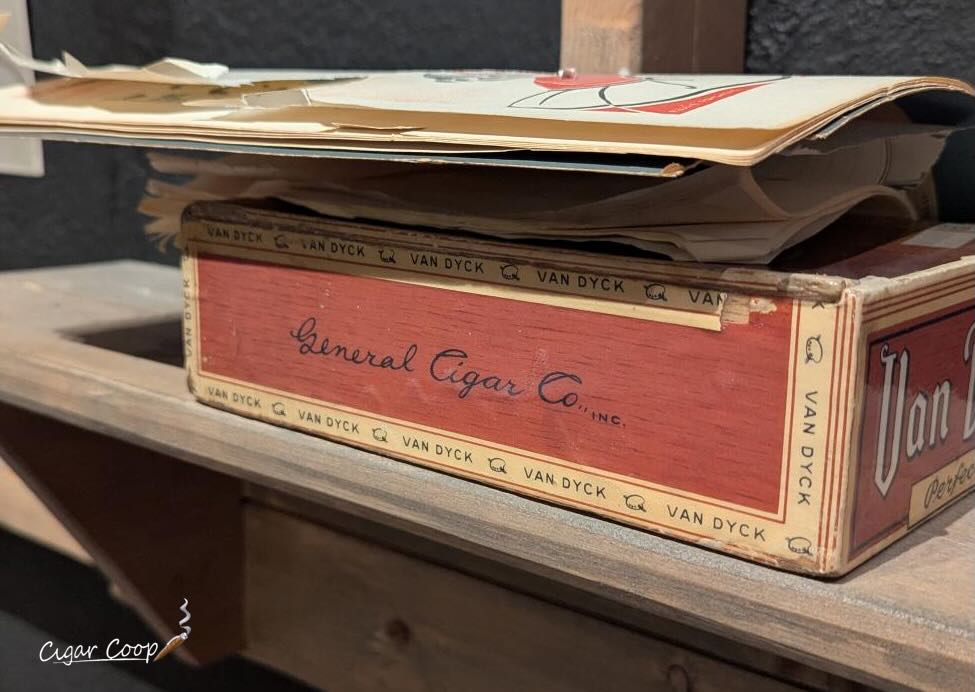
The Destination Colorado exhibit at History Colorado did have some old cigar boxes on display. The brands on them were authentic. It could have been very easy for History Colorado to take this out of the exhibit; they did not. Here is a short video where we look at some of the cigar boxes.
Here is some more of the other (non-cigar box) artifacts in the Destination Colorado exhibit:
Camp Amache Barrack Exhibit
During World War II, 120,000 Japanese and Japanese Americans were forced into internment camps—including one in Colorado. This is one of the darkest periods in our nation’s history. The one in Colorado was called Camp Amache (the Granada War Relocation Center). History Colorado has an exhibit with the purpose of remembering the wrongful imprisonment of Japanese Americans. The exhibit includes a model of one of the barracks at Camp Amache.


One thing I noticed in the barracks was the presence of cigar boxes. While I’m not trying to portray a positive image of the experiences at Camp Amache, I found the cigar boxes intriguing. Similar to the Destination Colorado exhibit, these boxes featured genuine brands. Just like with the Destination Colorado exhibit, it would have been easy to exclude such artifacts, but I’m pleased they didn’t.

Final Thoughts
I was really happy there wasn’t a repeat of what the Tampa Bay Rays did to those Tampa Smokers jerseys. Colorado is not exactly known as a friendly space for tobacco, and in particular cigars. However, it was great to see history preserved. If you love tobacco and love nostalgia, this is the exhibit for you. History Colorado is a wealth of information, and if you are in Denver, check it out.
Photo/Video Credits: Cigar Coop