Since the cigar boom of the 1990s, there’s no brand that has been managed quite like OpusX. I’d be hard-pressed to believe that there’s a single cigar company—including Habanos S.A.—that wouldn’t like to have its own OpusX.
It’s a brand that has an incredible backstory. The short of it is that in the early 1990s, the owner of Boutique 22, a shop in Paris, was visiting the Fuente operation in the Dominican Republic. During that visit, the owner remarked to the Fuentes that they weren’t cigar producers; they were cigar assemblers. His point was that because Arturo Fuente didn’t make a cigar only out of tobacco it grew, the company was assembling cigars. The issue was that cigar companies had not successfully grown wrapper in the Dominican Republic, at least not commercially usable wrapper tobacco.
Carlos “Carlito” Fuente Jr. set out to prove that person wrong, planting an experimental crop that would, in 1995, debut as OpusX. Even after 30 years on the market, Fuente Fuente OpusX is the only cigar brand that is consistently put on shelves with prices above MSRP, a clear sign of how the market feels about the cigar.
In the last few years, there’s been a noticeable uptick in OpusX projects, even a separate OpusX-branded company, but it’s not as if the OpusX variants began in the last five years. Whether it be the OpusX Angel’s Share or Oro Oscuro lines that Arturo Fuente sells, or the Lost City and Purple Rain cigars sold by Prometheus, there have long been different blends that borrow the same basic packaging as the standard OpusX line.
As of now, the newest variant is Templo de Oro.
Late last year, Fuente Jr. began teasing the line, which is Spanish for golden temple, and it arrived—relatively unannounced—at stores in December.
Fuente Jr. has long stopped publicly talking about blends, though when asked, he told halfwheel that it was designed to be creamier.
“When you smoke it, you can tell it’s a Fuente-made cigar, it’s got the Fuente house style, but it’s just totally different,” said Fuente Jr. to halfwheel in December. “I think it’s a lot creamier than any of the Opus I’ve made, it’s made that way intentionally.”
The line debuted in four vitolas:
- Fuente Fuente OpusX Templo de Oro #1 (6 1/8 x 50) — $29.50 (Box of 20, $580)
- Fuente Fuente OpusX Templo de Oro #3 (5 1/2 x 52) — $28 (Box of 20, $560)
- Fuente Fuente OpusX Templo de Oro #8 (6 1/8 x 55) — $32 (Box of 20, $640)
- Fuente Fuente OpusX Templo de Oro #13 (6 x 58) — $32.50 (Box of 20, $650)
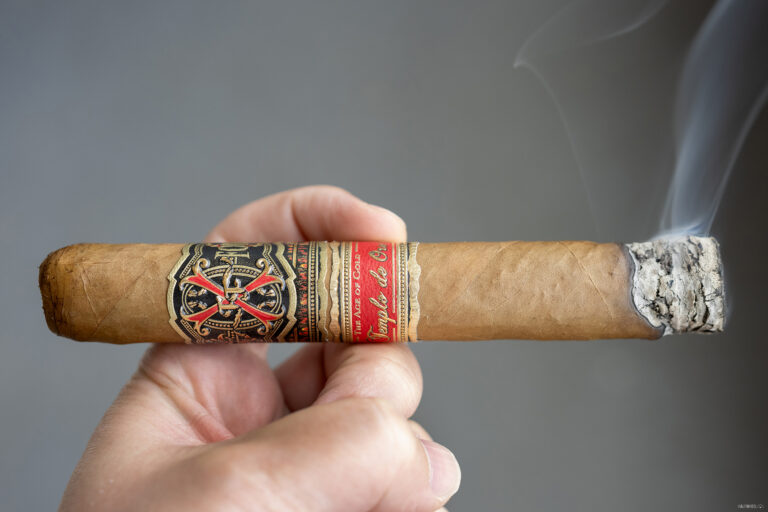
Packaging-wise, it borrows the ForbiddenX main band—which has been used on a long list of blends—but paired with Templo de Oro secondary band and a large gold foil covering.

- Cigar Reviewed: OpusX Templo de Oro #8
- Country of Origin: Dominican Republic
- Factory: Tabacalera A. Fuente y Cia
- Wrapper: Undisclosed
- Binder: Undisclosed
- Filler: Undisclosed
- Length: 6 1/8 Inches
- Ring Gauge: 55
- Shape: Round
- MSRP: $32 (Box of 20, $640)
- Release Date: December 2025
- Number of Cigars Released: Undisclosed
- Number of Cigars Smoked For Review: 3
Anytime I smoke a new OpusX, my first thought is to feel the wrapper. With the large piece of gold foil removed, these feel similar to regular OpusX, perhaps slightly softer and noticeably smoother. From a color perspective, I find it lighter and duller than OpusX 20th Anniversary, though I didn’t compare the cigars side-by-side. Visually, the wrappers have an average amount of veins and an above-average amount of discoloration, including a few dark spots. The aromas from the wrappers aren’t great: the first two smell like dirty pond water with barnyard, leather and a sweetness: graham cracker on the first cigar and powdered sugar for the second. The third cigar is milder—medium—with a scent that reminds me of egg whites. The feet are medium-plus with sweetness—milk chocolate for the first, apple juice for the second and generic sugar for the third—leading sawdust and some barnyard. Cold draws are dominated by a funky mixture of that pond water scent and some vinegar. It’s aggressive and not appetizing. The other flavors would be strong enough but are overwhelmed by that combination. That list includes woodiness, nuttiness, barbecue sauce, creaminess, and on the third cigar, an eye-squinting sharpness.
Fortunately, once lit, the OpusX Templo de Oro #8 avoids whatever that dominant flavor was on the cold draws. Instead, the cigars start out with a medium-full profile of woodiness and bread, slightly edging out oatmeal, an underlying sweetness and some mild white pepper. Those first puffs are medium-full with a very rounded flavor profile. The main flavor has what I’d consider the signature flavor of regular OpusX: a semi-sweet mixture of layered earth and woodiness. However, it lacks the oomph in the body. Other flavors include creaminess, barnyard, oatmeal, nuttiness and an isolated sweetness that reminds me of vanilla sweetener. The finish, especially on the third cigar, really leans into the OpusX signature with those flavors joined by sweet coffee and white pepper, though the most interesting note is a ginger candy on the second cigar. Retrohales take the main profile and make it denser, richer, sharper and less sweet. During the finish, the terroir elements pick up, as does some sharpness that reminds me of an alcohol-like burn. Flavor is full, body is medium-full and strength is medium. I wish the draw on the second cigar was slightly tighter, though the actual construction problems are uneven burns, albeit only the third cigar is bad enough to require me to use my lighter.

Nuttiness takes over the profile, a definitive change, though, given how the first third went, not exactly a sharp turn. The OpusX Templo de Oro #8 keeps most of the core flavors from the first third—woods, creaminess, earthiness, subtle sweetness—though they are all playing second fiddle to the smooth nutty flavor. As far as differences, the first cigar has a dry olor-like flavor, the second third has saltiness, and the third cigar has the most compact profile. The cigar gets toastier during the finish, though that’s the only major change. Retrohales of the first cigar add some buttered toast and hints of fruitiness to the flavors in the mouth, the second cigar is softer and sees the return of the vanilla sweetness, while the third cigar reminds me a lot of the first third. Flavor is full, body is medium-full, and strength varies between medium and medium-plus. At both the start and end of the second third, the second cigar needs to be touched up for uneven burn, though the other two cigars are burning just fine.

The final third sees the cigars drift away from the classic OpusX profile. The first and third cigars have earthiness and leather leading some black pepper, burnt coffee, and a varying amount of salt. Unfortunately, the second cigar seems to be affected by the burn issues, as it’s tasting quite toasty with some of the sweet woods, saltiness and a new tartness. All three cigars have more toastiness during their finishes, but the difference is how strong and isolated it is on the second cigar. While the woody and creamy flavors do a lot of work to cut through the toastiness on the other cigars, that doesn’t happen on the second cigar and I’m able to find more black pepper and a vodka-like burn. Leather and black pepper are found in each cigar’s retrohale, though the second cigar oddly adds some sweetness while the third cigar has a lot of the core flavors from the first half of the cigar. In general, the three cigars are getting drier as they burn down through the final third, though it never becomes overwhelming. Flavor remains full, body is still medium-full, but strength picks up to medium-plus to medium-full. The second cigar continues to need occasional assistance from the lighter to correct uneven burn lines, but the other two cigars are just fine.

Final Notes
- I generally try to avoid writing a review that is overly reliant on comparing one cigar to another. While I don’t think it’s the case for all of the OpusX variants, in this instance, the easiest way for me to try to explain the cigar is to compare it to the original blend.
- While there were some pretty notable differences, the largest one to me was the body. I find the core OpusX cigars to be medium-full in body and strength, but there’s a heavier substance to how the body affects the flavors than most medium-full cigars. That was not at all present on the Templo de Oro.
- Brooks Whittington prefers aged OpusX a lot more than I do, but I don’t think it’s as simple as saying the Templo de Oro tastes like a 30-month-old OpusX. The Templo de Oro had much clearer transitions than I find from most aged OpusX.
- Templo de Oro’s spot as the newest OpusX variant will only last for another month or two. Arturo Fuente plans on releasing the OpusX ReXilient before the 25th anniversary of Sept. 11. A few weeks ago, I was told that the packaging was almost finalized.
- Speaking of packaging, the main ForbiddenX band and the Templo de Oro secondary band have some slight inconsistencies. While our cameras are apparently not capable of capturing the difference, in person the gold edges on the secondary band are glossier than the main band. It’s possible that the gold colors are actually the same but the ForbiddenX bands on these cigars have faded due to being older.
- Like many other OpusX cigars, these cigars have a slight press on the sides. I don’t think it’s because the cigars are pressed at the factory, but pick up the soft press in the box.
- Arturo Fuente advertises on halfwheel.
- The cigars for this review were purchased by halfwheel. We paid just under 70 percent over MSRP.

- Arturo Fuente lists the OpusX Templo de Oro #8 as a 6 1/8 x 55 double toro. Above are the dimensions I found for the cigars I smoked for this review.
- Final smoking time ranged between two hours and 45 minutes and three hours.
- Site sponsors Cigars Direct and Small Batch Cigar list the OpusX Templo de Oro #8.
90
Overall Score
These are the only three OpusX Templo de Oros I’ve smoked, and my takeaway is that this release is very good news for fans of the original OpusX. You don’t need to go through any hoops to track these down and spend extra money to buy them. If you like the regular OpusX blend and haven’t gotten to smoke this yet, I don’t think you are missing much. Compared to any of the core OpusX variants like 20th, Angel’s Share, Oro Oscuro, etc., these were—especially in the middle parts—as close to regular FFOX as I’ve experienced. I found the blend to be like some of the ForbiddenX cigars or OpusX 25, orbiting the regular blend but not a direct clone. For me, the difference between this and regular OpusX was that Templo de Oro tasted like a slightly tamed-down version, lacking the thickness and body that I enjoy from the original blend, at least when smoked relatively fresh. The Templo de Oro is a very good cigar, only let down in this review by some burn issues, but I don’t see how it will be any sort of revolution for OpusX fans. Quite frankly, it looks more different than it tastes.
Arturo Fuente
Dominican Republic
Double Toro
Fuente Fuente OpusX Templo de Oro
Fuente Fuente OpusX Templo de Oro #8
Tabacalera A. Fuente y Cia