When it comes to family lineages in the tobacco industry, the Eiroa family can claim more than a century in the business. A new line, 1916 Tabacalera Eirora, pays tribute to the heritage, with the fourth generation of the family credited with developing the blend.
Santi Eiroa, the youngest son of Christian Eiroa, founder of CLE Cigar Co., came up with an all-Honduran blend, highlighted by a five-year-old habano wrapper and binder, while the filler contains corojo and pinareño tobacco.
“My father, Christian, prefers fuller-bodied cigars, yet my grandfather, Julio, leans milder. I tend to prefer something in the middle, and I often wonder what my great-grandfather, Generoso Eiroa’s, preference was,” said Santi Eiroa in a press release. “This blend reflects that balance, a bridge across generations.”
The pinareño seed was brought to Honduras by Tino Agurdin in 1960. While flavorful, it also produces smaller yields and is known for being more delicate and disease-prone than corojo. For the past several years, the Eiroa family has been revisiting the leaf, with the two Eiroa family-owned companies—CLE and JRE Tobacco Co.—introducing blends using pinareño.
It’s made at The CLE Factory in Honduras and offered in five sizes:
- 1916 Tabacalera Eiroa Robusto (5 x 50) — $16 (Box of 18, $288)
- 1916 Tabacalera Eiroa El Gordo (5 1/2 x 60) — $19 (Box of 18, $342)
- 1916 Tabacalera Eiroa Toro (6 x 52) — $17 (Box of 18, $306)
- 1916 Tabacalera Eiroa Belicoso (6 1/2 x 50) — $18 (Box of 18, $324)
- 1916 Tabacalera Eiroa The Personal (5 1/2 x 44) — $16.50 (Box of 18, $297)
The name of the line comes from the year 1916, when Generoso Eiroa, Santi’s great-grandfather, planted his first crop of tobacco in Cuba.
While it is a regular production cigar, it is being limited to just a small portion of CLE’s retail accounts. In the U.S., the company said just 100 retailers will have access to 1916.

- Cigar Reviewed: 1916 Tabacalera Eiroa Toro
- Country of Origin: Honduras
- Factory: The CLE Factory
- Wrapper: Honduras (Habano)
- Binder: Honduras (Habano)
- Filler: Honduras (Corojo & Pinareño)
- Length: 6 Inches
- Ring Gauge: 52
- Shape: Round
- MSRP: $17 (Box of 18, $306)
- Release Date: May 2026
- Number of Cigars Released: Regular Production
- Number of Cigars Smoked For Review: 3
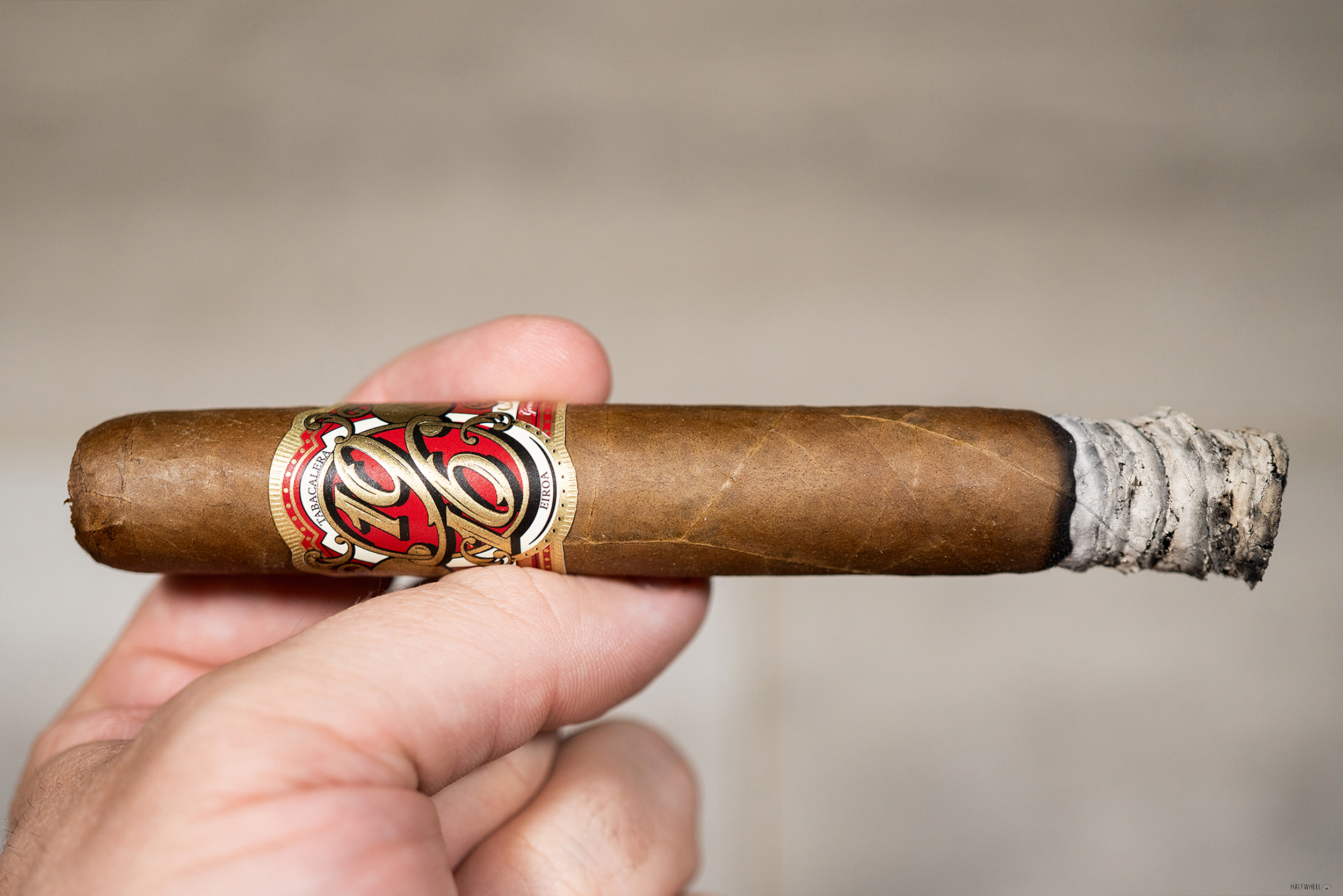
The bands on the cigars are very eye-catching thanks to the stylized 1916 that takes up a good chunk of real estate. I’m surprised that the Eiroa name doesn’t feature more prominently, sitting in small font underneath that number. The wrapper leaves have a really beautiful network of veins, about average in number but more importantly, prominent but not obtrusive, and arranged in a very clean layout, as opposed to a haphazard network. The wrappers are all on the dry side with a bit of fine texture to my fingers, not prominent enough to be called gritty, however. While the first cigar is generally firm, there is a soft spot on the back of it that reminds me of the kind of soft spot I’d find on an apple that’s starting to turn. The other two cigars are firm as well and don’t show any spots of concern. The aroma off the foot reminds me of apple pie with cinnamon, though more of a packaged version than a fresh-baked one. It’s also more filling than crust, with a touch of cool creaminess behind that. The third cigar has a dialed-in version of the aroma that really reminds me of an apple-flavored Nutri-Grain bar. The cold draw is a bit simpler, more pie crust than pie filling, with a subtle tingle on my lips from the wrapper. The airflow is good, with two cigars leaning to the firm side and the third a touch on the open side, but none are too far from ideal.
The first cigar starts with a mix of creaminess and pepper, while the second is a bit drier, and the third is led by more of a dry, earthy flavor that makes me think of Honduran terroir. None of the expressions are overpowering, but rather a medium intensity start that steadily increases in intensity right out of the gate. Through the nose, the smoke is crisp and peppery, a fairly lively experience, whether taking a retrohale or just getting some ambient smoke from a puff. Retrohales also help wake up my palate, as it seems like subsequent puffs have more detail than the one prior. The creaminess eventually comes around in the first inch or so of all three cigars, though in the third, it has to contend with a more prominent earthiness that wants to drive the profile. By the one-inch mark or so, the first two cigars are quite similar, while the third has a more prominent Honduran earthiness that is both quite dry and mouth-drying. Thankfully, the next puff after I write that sentence benefits from a surge of creaminess, softening the first part of the flavor while leaving earth and pepper dominating the finish. The section closes with some more pepper in the retrohale that really gets my nostrils tingling. Flavor starts medium but builds to medium-full, body is medium and strength is medium-minus. Construction is great thus far.

Thinking back to the apple filling aroma I picked up from the foot of the cigar, I find myself hoping it makes an appearance before long, as it would seemingly pair really well with what the 1916 Tabacalera Eiroa Toro is offering at the start of the second third. The body of the smoke thins out here as well and now sits more lightly on my tongue. It also seems like the finish is sticking around longer, as I can pick up a subtle tingle on the front of my tongue well after I’ve expelled the smoke from my mouth. The terroir begins to fade a bit, allowing the creaminess to step in, but that, too, doesn’t stick around for long, and around the midpoint, I have smoke with a really mild flavor beyond the peppery finish, while retrohales hang onto the pepper and some creaminess for a contrasting sensation. Creaminess is the first to return to the profile as it begins rebuilding after the midpoint, with the terroir not too far behind, and the pepper fluctuating in its intensity across the three cigars as they approach their final thirds. In this section, flavor goes from medium-full to medium-minus to medium-plus, making for a rather interesting journey. The body changes a bit as well, from medium-plus to medium-minus and back to medium-plus, while strength is holding steady at medium-minus. Construction continues to be very good, with my only note being that the ash flowers a bit in the first cigar, but stays tight and dense as it builds up to well over an inch in length in the others.

At the start of the final section, the first cigar has a little woodiness that is just out of harmony enough that it stands out, almost misbehaving in order to garner some attention. It’s a change that I think could be done better, with the second and third cigars proving me right, as they give me some cedar that gets accented by black pepper on the finish. The pepper leads the retrohales, with just enough edge to command attention without diminishing its enjoyability. At some point not too far into this section, the flavor begins to settle into a fairly even combination of its three main components: creaminess, dry Honduran terroir, and bright black pepper. There are a few touches of woodiness that flit in and out, sometimes cedar, sometimes rough-cut lumber, but otherwise it’s a much more relaxed profile than what has been offered thus far. The home stretch of the 1916 Tabacalera Eiroa Toro adds what registers as a more traditional earthiness on my palate to give the profile some weight and the smoke some thickness, though the sensation quickly becomes more like a hearty, meaty broth in the final puffs. Retrohales stay bright and lively with black pepper, and that pepper has a tendency to increase in the profile as the cigar comes to a close. Flavor is medium-plus, body is medium-plus, and strength is still medium-minus. Only one touch-up is needed among the three cigars, mainly to help rev up the combustion. Otherwise, all three cigars burn well with smooth draws, plenty of smoke, and even burn lines.

Final Notes
- While there’s not a leaderboard of the youngest people ever to have their own cigar blend that goes on sale worldwide, Santi Eiroa would have to be in contention. He is not yet old enough to legally purchase these cigars for himself in America.
- The ash on the second cigar was quite impressive, building up consistently to reach and exceed the one-inch mark, making me increasingly nervous that it would come crashing down at some point.
- I’m not one to see how big of an ash I can build up, but every once in a while, a cigar will impress me enough to test it, as was the case here.
- To be clear, ash durability and length do not factor into the score a cigar gets. Ash is not part of the halfwheel scoresheet.
- You can see pictures of the launch event for the 1916 Tabacalera Eiroa Toro, held in Marrakesh, Morocco, here.
- Santi Eiroa is also credited with spearheading the company’s Aviator Series, a limited edition that came in luggage-inspired packaging.
- While there was a near-constant sense of some nicotine, I didn’t ever feel any effects of it during or after any of the three cigars.
- CLE Cigar Co. advertises on halfwheel.
- The cigars for this review were purchased by halfwheel.

- The company lists these as a 6 x 52 toros. The numbers above are the measurements we found for the three cigars used for this review.
- While measuring the cigars, Charlie noted that the barcode sticker used to close the cellophane—a common feature—were very difficult to tear. They wanted to stretch and took a couple of seconds to break.
- Final smoking time was two hours and 25 minutes on average.
- Site sponsors Corona Cigar Co., and Small Batch Cigar carry the 1916 Tabacalera Eiroa Toro.
89
Overall Score
The 1916 Tabacalera Eiroa Toro is a really well-done cigar, blending some familiar Honduran terroir flavors and woodiness with sensations I don’t often find, namely that apple pie filling. Looking back at my notes and Santi Eiroa’s comments about blending not just for his palate but for those of other generations of the Eiroa family, I can see how the blend’s consistent shifts and adjustments aim to deliver notes that they would all enjoy. But more impressively, this doesn’t try to be a one-size-fits-all profile, or play it so safe that there’s nothing memorable about it. It’s an impressive creation by Santi Eiroa, who I have a feeling we will be seeing more of in the near future.
1916 Tabacalera Eiroa
1916 Tabacalera Eiroa Toro
CLE Cigar Co.
Santi Eiroa
The CLE Factory
Toro