In 2010, when I first started writing about cigars, there was a lot happening at EO Brands, the company that was co-owned by Erik Espinosa, Eddie Ortega and, at one point, Rocky Patel. EO Brands sold cigars like 601, Cubao and Murcielago, which were then distributed by Rocky Patel Premium Cigars, Inc. Looking back on it, that time was perhaps also the last big push the partners made to try to keep EO Brands around.
Just two years later, both Espinosa and Ortega had announced their own companies, dissolved EO Brands and split up the brands. Ortega kept Cubao and some of the older trademarks, while Espinosa moved 601 and Murcielago to the then relatively new Espinosa Premium Cigars.
The original 601 debuted in 2006, when the company was known as United Tobacco, not to be confused with the completely separate company, United Cigars. The original blends were made by José “Pepín” García, then of El Rey de los Habanos fame. Looking back at an RTDA 2006 write-up from moki, a forum user best known for his work documenting rare Arturo Fuente products at vitolas.net, it’s interesting to see just how many humidor mainstays debuted at that trade show. That trade show was the first appearance of Liga Privada, the debut of Ashton ESG, and an update about upcoming OpusX tins.

Shortly before the 2026 PCA Convention & Trade Show in April, Espinosa Premium Cigars announced a bevy of new releases, most of which have arrived on shelves. One of them was the cigar made to honor the two decades of 601.
The 601 Blue 20th Anniversary is offered in a lone 6 3/4 x 56 parejo that gets an oval press. Blend-wise, it uses a Connecticut broadleaf wrapper—the same varietal used for the regular 601 Blue—over a Nicaraguan binder and Nicaraguan fillers. It is made at AJ Fernandez’s San Lotano Factory in Ocotal, Nicaragua.

- Cigar Reviewed: 601 Blue 20th Anniversary
- Country of Origin: Nicaragua
- Factory: San Lotano Factory
- Wrapper: U.S.A. (Connecticut Broadleaf)
- Binder: Nicaragua
- Filler: Nicaragua
- Length: 6 3/4 Inches
- Ring Gauge: 56
- Shape: Pressed
- MSRP: $18 (Box of 10, $180)
- Release Date: May 2026
- Number of Cigars Released: 4,000 Boxes of 10 Cigars (40,000 Total Cigars)*
- Number of Cigars Smoked For Review: 3
*Espinosa Premium Cigars says it is making at least 4,000 boxes but is open to making more.
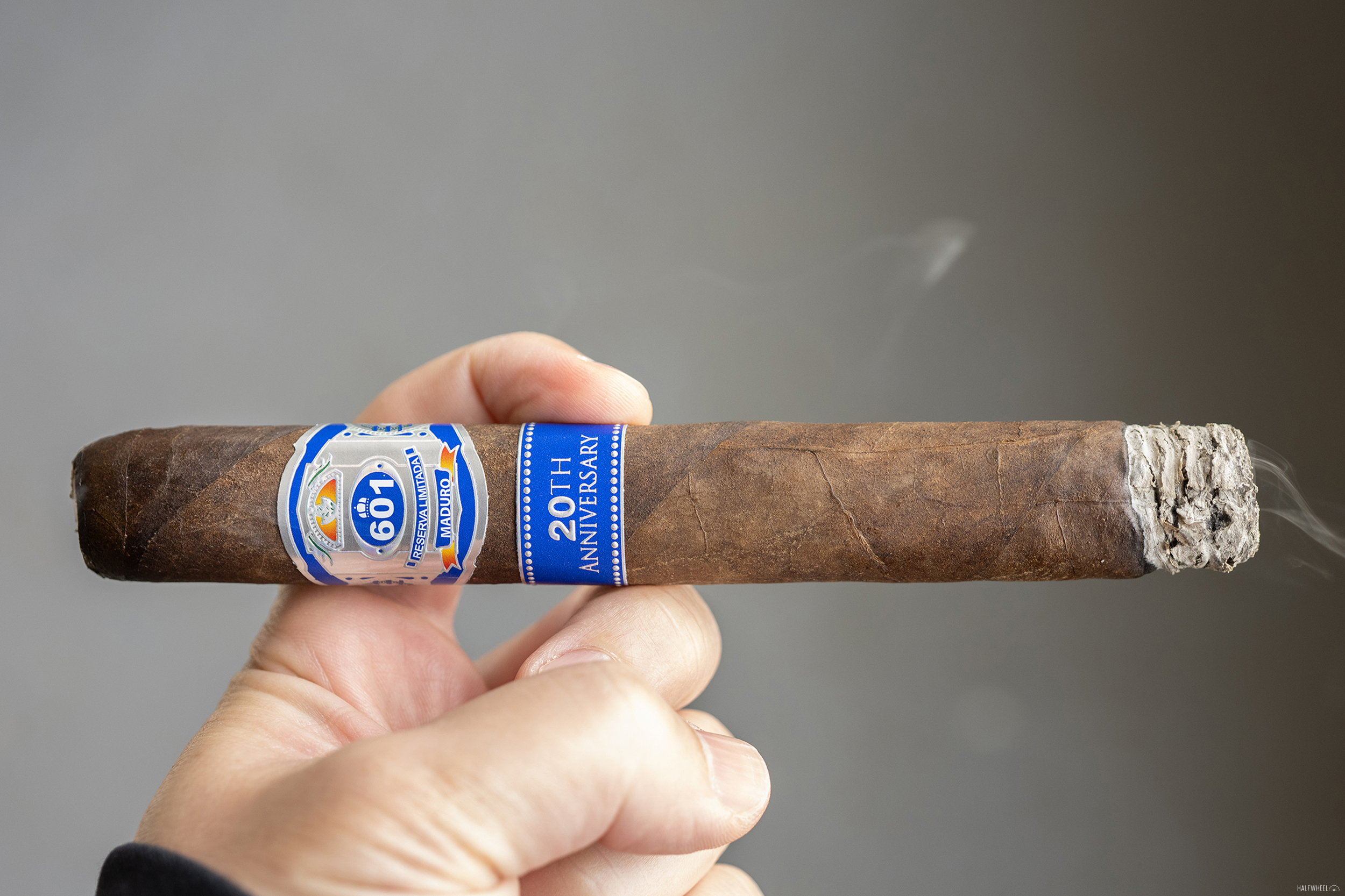
Until the cigars arrived, I had forgotten that this release uses an oval press. It’s a feature I more associate with Knuckle Sandwich Cigars, a sister brand of sorts, but is certainly not something I’d expect for a 601. From a medium distance, all three cigars look the same, but up close, the first one has some weird traits. The front and back panels both have veins that are medium in thickness, but run multiple inches up and down the surface of the wrapper. I imagine the person putting on the bands was not impressed with how the leaf was placed on the cigar. Regardless, these are very dark wrappers with no real discoloration. The first and third cigars have a weird texture, almost like someone applied a rough shave to the area. The aromas from the wrapper are quite similar: medium-full with toasted bark, sweet cocoa, and varying levels of barnyard. The feet smell pretty similar too: muted with the same scents as the wrappers, though they are more muted, and an added chili pepper. Cold draws are consistently medium-full and tend to be pretty sweet. The first cigar has woods, milk chocolate and sweet tea; the second adds a dirty water flavor, which stands out like a sore thumb; and the third has raisins, barnyard, leather and a touch of strawberry, though it’s less sweet than the other two cigars.
The three cigars start very similar: full, smooth and with roasted and woody flavors dominant. Different types of earthiness, granola, leather and even some buttered popcorn are part of the initial flavor, but the more impressive aspect is how little the 601 Blue 20th Anniversary changes. I find most cigars to have a much more distinct first few puffs, something that rarely holds up after just a few minutes, but this is a cigar where the 20th puff is nearly identical to the first. Burning wood is the dominant flavor with earthiness, leather, burnt coffee, and black pepper serving as secondary notes. Each cigar is a tad different: the first has a more compact flavor, the second is sweeter, and the third is creamier. The finish has the creaminess and pepper—black pepper most of the time, but red pepper too—along with more sweetness in the third cigar. Retrohales are the only way to really taste something different. It’s a much more balanced mixture with leather, creaminess, toastiness, grains and different types of sweetness. Oranges in the first cigar, green tea in the second, and a generic sweetness in the third. The first two cigars add a more generic black tea flavor during the finish, but it’s mostly the same list of flavors. Intensity-wise, flavor is full, body is medium-full and strength is medium. Unfortunately, both the first and third cigars have some weird combustion hiccups. Fortunately, only one touch-up is needed for each.

While the burning wood flavor remains the largest part of the profile, creaminess is becoming more prevalent both in its intensity and frequency. The core flavor is still a layered mixture between the woody flavors, leather, earth, pepper and the creaminess, though the exact arrangement varies between the three cigars. The finish is generally drier, though it goes through more transitions than the main flavor. The earthy and leather flavors are present more early on, though the finish gets sweeter and spicier as the final third nears. The sweetness reminds me of a watered-down spiced rum, though it’s mostly just a secondary note. Retrohales continue to have some more distinct earthy flavors like mud and minerals, though the more unique, albeit occasional, flavors are peanut butter and kiwi. Still, my notes suggest a lot of the same sensations: creaminess, saltiness and black pepper. Flavor is full, body is medium-full and strength is medium-plus. The first cigar has another moment when a touch-up is needed, though for the majority of puffs, combustion is more than good.

Leather moves earlier up the profile and once the smoke enters my mouth, it’s usually the first flavor I detect. The toastiness is now specifically attached to the earthiness, the woodiness a bit sweeter and not as strong, though the list of flavors is more or less identical to where the cigar started. Black pepper and creaminess both pick up more during the finish, though the most noticeable change is that the saltiness has been reduced. I’m a bit surprised that the leather is also the leading flavor of the retrohale, though again, it’s a lot of the same flavors. In fact, my notes from the second cigar describe it as a “slightly smoother and more detailed version of the flavor in the mouth.” Again, the flavors reorder themselves during the finish, though the list of flavors has zero new entries compared to what I’ve previously tasted. Flavor is full, body is medium-full and strength ranges from medium-plus to medium-full. Both the first and third cigars need one more touch-up each.

Final Notes
- If you are looking for a full-flavored but smooth profile that delivers these types of classic cigar flavors without a ton of sweetness, this is such a good option. For me, rich, smooth and consistent are the best three descriptors.
- However, because of how few changes there were, I found myself wanting another feature. In terms of adding a new flavor, a more persistent sweetness or sharpness could have gone a long way. A dynamic flavor change between the sections, even just one, probably might have helped. I also think that having the retrohale be unique from the mouth flavors could have been the answer.
- The combustion issues, especially in the first half of the cigars, were odd. There was plenty of visible smoke and rarely any let-up, but in the first and third cigars, there were isolated moments when I’d try to take a puff and no smoke would come out. While I could see the cigars producing smoke from the feet, I’m concerned with what’s happening from the other end of the cigar. The first cigar, the most problematic of the bunch, required just one touch-up for each third, hardly a huge problem for a cigar of this length.

- I noticed the bands are cut in a non-uniform way; you can see that the left side is smooth, whereas the right side has a sharp indent.
- One other quirk, the main bands, which are slightly different than the standard 601 Blue band, say “Hecho a Mano Estelí, Nicaragua” which isn’t accurate. Ocotal, where the cigars are made, is about 90 minutes north of Estelí.
- The cigars for this review were purchased by halfwheel.

- Espinosa Premium Cigars lists the 601 Blue 20th Anniversary at 6 3/4 x 56. Above are the dimensions I found for the three cigars I smoked for this review.
- Final smoking time averaged two hours and 35 minutes.
- Site sponsors Atlantic Cigar Co., Cigars Daily, Cigars Direct, JR Cigar, LM Cigars and Small Batch Cigar carry the 601 Blue 20th Anniversary.
89
Overall Score
The 601 Blue 20th Anniversary is right near the edge between “good” and “very good,” with perhaps its most unique trait holding it back. The cigar’s overall flavor was an extremely well-executed version of the sum of its parts. But this was a cigar that more or less had one singular flavor profile, presented it in a way that I’m unsure leaves much room for any sort of improvement. If you like that profile, you are going to love this cigar, at least in its relatively fresh form. However, it’s so consistent that I think it holds the cigar back from some depth required to be considered for the next level.
601
601 Black
601 Blue 20th Anniversary
Double Toro
Espinosa Premium Cigars
Nicaragua
San Lotano Factory